
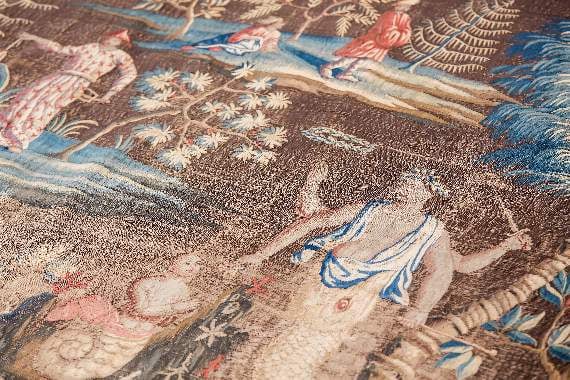
AN appeal has been launched by the National Trust to save a collection of internationally important 18th century Hampshire tapestries.
They are six of the most important tapestries in the Trust’s ownership and they are leaving their home at The Vyne, Sherborne St John, near Basingstoke, for a ‘bath’ in Belgium.
The 18th century ‘chinoiserie’ tapestries urgently need extensive conservation work. Historic repairs have begun to fail and the tapestries’ backings have warped, putting strain on the fragile fabric.
The work will cost the charity in the region of £382,000, and The Vyne has launched an urgent appeal to help fund the project, and ensure the magnificent tapestries can continue to be enjoyed by visitors to 16th century house.



Built for Lord Sandys, King Henry VIII’s Lord Chamberlain, the house retains its Tudor chapel, with stained glass, and last year was subject to a £5.4m project to repair a leaking roof and crumbling chimneys.
With the refurbished roof now securely in place, The Vyne has moved on to launch an urgent appeal to raise the remaining £35,000 to enable the tapestry conservation project to go ahead.
The tapestries were woven c.1720 carrying on the legacy of Chief Arras Worker John Vanderbank.
“Vanderbank was the leading tapestry weaver of his time”, explained house steward Dominique Shembry, “and these tapestries are notable for their use of ‘chinoiserie’ motifs. This style is an 18th Century European take on eastern art and culture. Vanderbank was instrumental in the introduction of the style to tapestry weaving.”
Fascination with the exotic was widespread thanks to the increased, yet still restricted, access to Eastern culture through expanded trade. The tapestries are an important result of the exchanges between the East and Europe.
The tapestries depict scenes from eastern folklore and legends such as the Oath of the Peach Garden, which captures the moment when three ill-fated heroes swear their allegiance to the Han Dynasty in what has been described as ‘an expression of deepest loyalty in Chinese culture’.
Further research has revealed that, while many examples of these tapestries survive, Vanderbank was able to produce them as a series of bespoke ‘one-offs’, allowing those who commissioned his work to pick from his cartoons and put each image where they wanted it.
He was thus able to produce tapestries of varying sizes and designs from a pre-prepared style.
In June the textiles will be travelling to the Royal Manufacturers De Wit in Belgium – the world’s leading restorer of tapestries. There, they will undergo a process known as ‘wet cleaning’, before returning to the UK for major conservation treatment, estimated to take three years.
‘Wet cleaning’ will see the tapestries laid out on a ‘suction table’ while a mist of mild detergent is gently drawn through the historic fabric to remove any dirt.
After cleaning, the tapestries will be laid out and covered with cloth to absorb the moisture. Once dried, they will be carefully rolled up and transported back to the UK.
Before the textiles are sent abroad, the National Trust team must ensure the tapestries won’t become damaged during this process. For that reason some of the historic repairs made using different materials and dyes are being taken off. This is to make sure the colours won’t run and that the patch repairs won’t shrink and put additional stress on the fragile fabric. The backings and edges - called ‘galloons’ - are also being removed, while rips and tears are being reinforced with extra stitches.
The Vyne’s house and dollections manager Helen Sanderson: “What’s striking is the amount of preparation that goes into each tapestry ahead of just eight minutes of wet cleaning.”
By the time the tapestries ‘take the plunge’, they’ll have spent three months under the expert gaze of a textile conservator.
The conservation project has received some financial support from the National Trust. However, with a total of 250,000 hectares of countryside, 778 miles of coastline and hundreds of special places across England, Wales and Northern Ireland to look after, the Trust must look to the generosity of its supporters to meet the shortfall.
Visitor experience and fundraising manager Hollie Ryan said: “It’s really easy to support conservation efforts like The Vyne’s Tapestry Project. You can donate remotely by phoning 01256 883858 or you can make a contribution during your visit.”
Comments
This article has no comments yet. Be the first to leave a comment.