
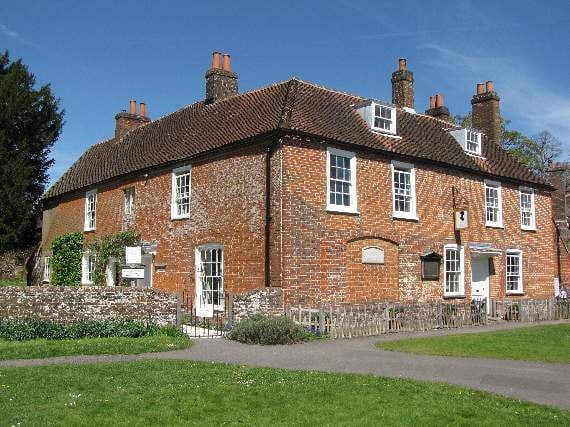
Jane Austen’s House Museum in Chawton has launched its bicentenary commemorations by taking the first steps toward recreating the interior of the house as it was in Austen’s day.
The house was Austen’s home for the last eight years of her life and the place where she wrote or revised all her novels.
Following the discovery of a number of fragments of two Regency wallpapers in out-of-the-way corners of the house – dating from the early 19th Century and the period in which Austen would have been living there with her mother and sister – the museum commissioned Hamilton Weston Wallpapers to reconstruct the patterns from these fragments and to create replica wallpapers.
Specialists in historic and reproduction wallpapers, Hamilton Weston has used the same hand block printing processes that would have been used during the 19th Century to create the designs.
.png?width=209&height=140&crop=209:145,smart&quality=75)



A centre element of the trellis design on the fragments found in the Austen’s family room initially proved a mystery to Hamilton Weston’s architectural historian, Robert Weston. After thought and research, he realised that the pin-print motif on the design was actually the stem of a rose bud but with the bud print omitted.
In addition, the wallpaper had been hung upside down, potentially to disguise the missing bud. It was printed incorrectly, perhaps by an early 19th Century apprentice to the trade, and, as the household was not rich, one theory is that they bought the design cheaply as a ‘second’ from the printers, as wallpaper was very expensive and heavily taxed from 1714 to 1836.
Both replica wallpapers are now hanging in the rooms from which the corresponding fragments came - the “Chawton Vine” design in the drawing room and the “Apprentice Ribbon Trellis” in the upstairs family room – for visitors to view when the house reopened last Friday. Both designs, as well as a third, the “Chawton Rosebud Moiré”, which features the rosebud believed to have been the intended outcome, are available to buy via the museum shop.
Hanging the replica wallpapers is an important first step toward recreating the interior of the house as it was in Austen’s day. Further reinterpretation will be completed once vital building repairs to the Grade I Listed house have taken place. Recent surveys have shown that fundamental repairs are required to ensure that the fabric of the house does not deteriorate further. To that end, and to mark 200 years since Austen’s death, the museum has launched Jane’s Fund, an appeal to restore and protect the house where she lived and wrote some of her most celebrated works. The aim is to raise £250,000 toward the first phase of exterior and interior building repairs, restoration and refurbishment of the house.
Pledging their support to Jane’s Fund during this significant year are the museum’s 2017 ambassadors – historian, author, presenter and chief curator at Historic Royal Palaces, Lucy Worsley, whose new book, Jane Austen at Home, is published in May; number one bestselling author Joanna Trollope, who grew up with Austen’s works; and columnist, scriptwriter and bestselling author Kathy Lette, who credits Austen with her wanting to become a writer.
Joanna said: “It’s a rare experience to stand on the very spot where some of the best-loved novels in the world were written, but that’s what you can do in the Jane Austen Museum at Chawton. If any literary monument ever deserved our support, this modest, charming and atmospheric place is it.”
Lucy said: “Jane Austen lived her life in other people’s houses, and mostly on other people’s terms as a dutiful daughter or a helpful spinster aunt. Only when she finally moved to the cottage at Chawton did she find something like a real home. I hope that Jane’s Fund will secure the future of this modest, but oh-so-moving, building forever.”
And Kathy added: “Beneath her humorous veneer, Austen is a barbed commentator on the battle between the sexes. As a woman writer, she realised that poetic justice is the only true justice in the world and set about impaling misogynistic enemies on the end of her pen. It was Jane Austen who made me want to write novels so that I, too, could comedically knee-cap the pompous, the pretentious and the patriarchal.
“Jane’s former home must be protected as a place of inspiration for future generations.”
To help Jane’s Fund, visit justgiving.com/campaigns/charity/jahm/janesfund.
Running in parallel will be the launch tomorrow (Friday) of ‘The story of Jane Austen’s Life and Legacy’, told using 41 objects from the museum collection.
Jane was only 41 years old when she died in 1817, and ‘Jane Austen in 41 Objects’ takes the form of an evolving exhibition alongside a series of online posts by guest writers published weekly throughout this bicentenary year. Each object and accompanying text explores a different aspect of Jane Austen’s life and work.
The last object will be revealed on December 15, one day before Jane’s birthday.
Comments
This article has no comments yet. Be the first to leave a comment.