
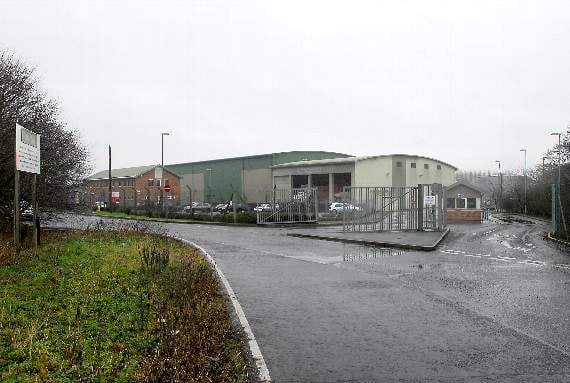
PARISH councils near Veolia’s recycling centre on the A31 have submitted early objections to expansion plans.
Critics said the proposal to build what is essentially a “power station” in a rural area bordering the South Downs National Park could lead to vast amounts of light and noise pollution.
The Alton Material Recycling Facility sorts through recyclable household waste, operating around five days a week.
However, in August Veolia published a scoping report looking at the potential impact of replacing it with an “energy recovery facility” that would operate 24/7.

This technology takes household waste that would have previously gone into landfill and burns it, producing electricity to export to the National Grid.
Veolia said although it is still in “the process of design evolution”, it anticipates the new facility would be of a far larger scale than the current centre.
At its highest point “the building would be approximately 50m above ground level”.
But it is the height of the chimney stacks that has caused the most concern. At “approximately 90m” these would be more than twice the height of nearby pylons.
Chair of Froyle Parish Council, Julie Southern, said members were “fundamentally against it” and submitted a detailed objection to Hampshire County Council.
They asked for further clarity on the increased lorry movements and said having “permanent lights which will be visible from miles around” would be “a great intrusion on the rural night sky”.
Ron Neil, chair of Binsted Parish Council, told the Herald its last meeting saw “a full room of objectors” voicing concerns. He anticipated a “vigorous campaign to object” should a full planning application arise.
The Alton Society’s Nicky Branch was surprised “the present facility of 125,000 tons per annum” will have to be “shut down and demolished”, leaving a gap of “around two years while the 330,000 ton facility is constructed”.
He said “surely Veolia can find another more suitable site, preferably in an industrial setting” and “avoid this dis-continuity”.
The firm insists energy recovery “makes an important contribution” to reducing the UK’s “long-term energy gap” and keeps waste out of landfill.
“Our energy recovery facilities are constructed and operate within the highest standards of environmental care, meeting or exceeding emissions legislation,” a Veolia spokesman said.
“During the planning and build process and beyond, we conduct a carefully targeted public information campaign to make this clear.”