
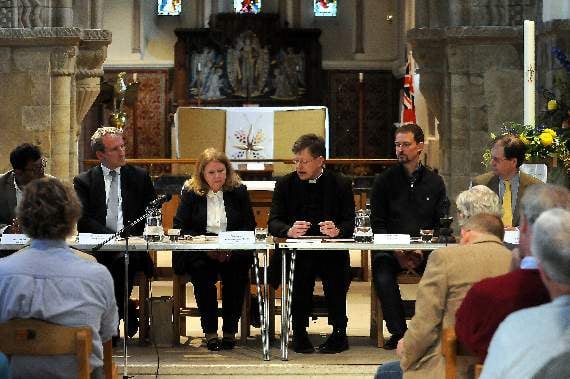
BREXIT, the NHS, housing and student tuition fees were among the issues debated by candidates hoping to win East Hampshire’s Parliamentary seat in next Thursday’s General Election.
The constituency’s hustings at St Peter’s Church in Petersfield took place on Tuesday night, having been postponed from the previous week following the Manchester terror attack.
The two-hour hustings was headed by Reverend Will Hughes and featured by prospective parliamentary candidates Damian Hinds (Conservative Party), Rohit Dasgupta (Labour Party), Susan Jerrard (Justice and Anti-Corruption Party), Richard Robinson (Liberal Democrats) and Richard Knight (Green Party). UKIP has not put forward a candidate.
As well as the Brexit negotiations, the NHS, affordable housing and student tuition fees, the candidates also addressed questions about the ageing population, voter representation, the bedroom tax, council tax, climate change and the long-term future of the UK.

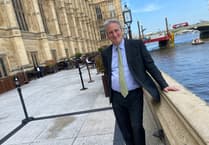

Mr Hinds - who lives between Alton and Petersfield and has been East Hampshire’s MP for seven years and is the Minister for Employment - said there would be a vote in Parliament at the end of the Brexit process and that all four main party leaders had voted to stay in the EU but were now faced with the result of the vote.
He said that Brexit will have to be seen through, that the UK will get a good deal and that it was in the common interest of the other 27 member states to benefit from a sensible and “bespoke deal, different from other EU countries”.
He said there would have to be an end to total freedom of movement.
Mr Dasgupta, who lives in London, said that the UK needed to have access to the European Medicines Agency, the EU agency which evaluates medicinal products, and medical research. There also needed to be access to European atom and nuclear energy, to security agencies and to intelligence, he said, adding that the UK should stay in the single market and customs union. He condemned the way Brexit had been handled and said: “No deal is not on the cards.”
Mr Robinson, an accountant who has lived in Buriton all his life, opposed a “hard Brexit” which he said “would do serious damage to international relationships and have severe consequences”.
He said the UK should remain in the single market and customs union in order not to damage the economy.
He felt it was important to have a new referendum on the deal offered.
Mrs Jerrard said she fully supported the Prime Minister’s determination to achieve a Brexit deal “which will free the country from the inefficient and expensive shackles of the failed European Union”.
Mr Knight opposed walking away from EU membership without any deal, which would not be good for business. He said collaboration was needed between the UK and the other 27 EU member states to achieve a better deal than before.
He felt the UK had to continue to allow people to come into the country and that the issue of border control needed to be looked at closely. He also felt that it was essential for UK citizens to have a second chance to consider Brexit.
On the NHS, Mr Hinds promised that the NHS “will be there in future” and that it had come forward with plans which involved the clever use of technology, the use of drugs, the configuration of local services and better local care.
Mr Dasgupta said with an ageing population, staffing and GP training would have to “fundamentally change”.
He said this could be achieved by increasing income tax by five per cent and that he still believed the NHS could continue to have quality and excellence.
Mr Robinson said the NHS could be protected by adding one penny to current contributions.
He felt that mental health and care of the elderly needed to be looked at specifically and that they need to be funded.
Mr Knight said the NHS was underfunded and that the burden was still on nursing staff.
Mr Hinds the Government had to act in the national interest, which included providing affordable houses, building a strong economy and addressing issues with the health and intelligence services and an ageing society.
He said raising corporate taxes would result in loss of business and jobs and, as regards tuition fees, graduates can earn up to £25,000 before having to pay anything back and that student debt is written off after 30 years.
Mr Dasgupta promised that Labour would put vast sums of money into health and social care, introduce “free education from cradle to grave” with the abolition of tuition fees, increase the minimum wage to £10 per hour and build more houses.
Mr Robinson called for more investment in schools, teacher recruitment and an education system that works for all.
Comments
This article has no comments yet. Be the first to leave a comment.