
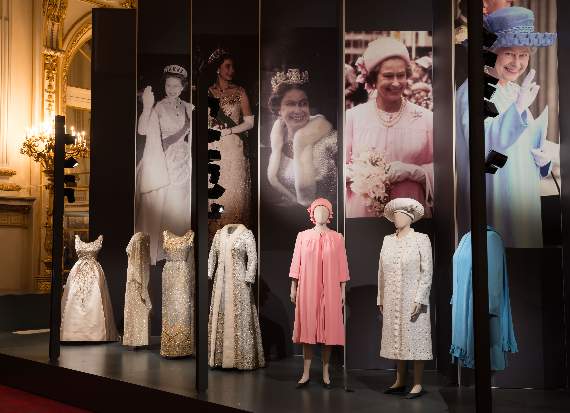
OUTFITS from across 10 decades of the Queen’s life and reign have been brought together for a special exhibition at Buckingham Palace this summer.
Visitors to this year’s summer opening of the state rooms at Buckingham Palace will be able to enjoy an unprecedented display of the Queen’s dress in the special exhibition ‘Fashioning a Reign: 90 Years of Style from The Queen’s Wardrobe’.
Spanning 10 decades, from the christening gown worn by the month-old Princess Elizabeth in 1926 to the vivid green ensemble worn by the monarch at this year’s trooping the colour celerony, the exhibition explores ceremonial and military attire, dress for state occasions and overseas tours, outfits for family celebrations, and Her Majesty’s support of British design.
Princess Elizabeth was christened in the private chapel at Buckingham Palace on May 29, 1926, wearing the white lace and silk-satin christening robe commissioned by Queen Victoria for her first child in 1841. Inspired by Queen Victoria’s wedding dress, the robe was worn by more than 60 royal babies up until 2004.




Her Majesty then commissioned Angela Kelly to create a replica gown, which was first used in 2008 for the christening of James, Viscount Severn, son of TRH The Earl and Countess of Wessex.
In 1937, Princess Elizabeth and Princess Margaret attended the coronation of their parents King George VI and Queen Elizabeth at Westminster Abbey. As princesses of the realm, they wore matching cream dresses made of lace and silk tulle with gold embellishment, and purple velvet robes, as stipulated by the Earl Marshall. Their outfits were completed by silver-gilt coronets.
Throughout her reign, the Queen has exclusively patronised British designers, including the great couturier Sir Norman Hartnell, who was responsible for many of the outfits worn by Her Majesty at state events, on tours and at family occasions.
In the post-war period, the Parisian couturier Christian Dior created a new style of dress with a more luxurious, feminine shape. This so-called ‘New Look’ was embraced by fashion designers around the world, including Hartnell. The glamorous black velvet and silk gown worn by Her Majesty in 1948 embodies this style, and is typical of the Queen’s evening dress in the late 1940s and early 1950s.
Arguably Hartnell’s best work for the Queen was his grand evening gowns and state occasion ensembles, but tailoring was also an important part of his collection each season. His tailor, Mr Driscoll, produced impeccable designs, such as the elegant red wool jacket and skirt worn by Her Majesty in the early 1950s, on display for the first time.
Between 1949 and 1951, Her Majesty spent long periods in Malta as a naval wife and in 1967 she visited the island as monarch on a commonwealth tour. By this time Hartnell’s evening wear had evolved, as seen in the much simpler silhouette of the embroidered blue lace and silk shift dress worn by the Queen for the state ball at the palace in Valletta.
For state visits and overseas tours, the Queen’s ensembles are carefully designed to ensure they are appropriate for the climate of the country and, where possible, fabric colours and embroideries are incorporated to pay subtle compliments to the host nation. For a state visit to Ethiopia in 1965, Norman Hartnell designed an evening dress in green, one of the country’s national colours, which the Queen wore with the Insignia of the Order of Ethiopia.
A mimosa-yellow silk-chiffon dress designed by Ian Thomas for the Queen’s 1974 visit to Australia is embellished with sprigs of wattle, Australia’s national floral emblem.
The Queen is well known for block-colour dressing, using bright, bold colours to ensure she is easily visible on important occasions. In 1986, the Queen attended a special 60th birthday parade on the Mall, when 6,000 children waved bunches of daffodils. Her Majesty wore a bright yellow tailored coat and dress by Hardy Amies, with a matching beret-style hat by Frederick Fox.
The Channel Tunnel was officially opened by the Queen and President François Mitterrand of France in May 1994. The vivid pink coat and dress by John Anderson worn by The Queen for the engagement, with a matching pill-box hat by Karl Ludwig van Rehse, is another example of how the choice of colour in Her Majesty’s dress ensures that she is easily seen.
On public display for the first time are outfits worn on two recent and memorable occasions. In 2012, the Queen played an unexpected role in the opening ceremony of the London Olympics, appearing to arrive by helicopter with James Bond. Two beaded peach cocktail dresses were created by Angela Kelly for the spectacle, one for Her Majesty and the other for the stunt double.
In June this year, the Queen attended Trooping the Colour, the official celebration of Her Majesty’s 90th birthday. To inspect soldiers from her personal troops, the Household Division, The Queen wore a vivid green wool-crepe and silk dress and coat by Stewart Parvin and a wool-crepe hat by Rachel Trevor-Morgan.
The exhibition at Buckingham Palace is one of three separate special displays in celebration of the Queen’s 90th birthday at each of Her Majesty’s official residences during 2016. Around 150 outfits will be shown across the palaces, and the content of each exhibition has been selected to have particular association with the location.
At the Palace of Holyroodhouse the use of tartan in royal dress is explored, while at Windsor Castle magnificent evening gowns worn on official occasions will be contrasted with Princess Elizabeth’s fancy-dress costumes from wartime family pantomimes held at the castle.
n The three exhibitions – Fashioning a Reign: 90 Years of Style from The Queen’s Wardrobe – are at the Palace of Holyroodhouse until October 16, the Summer Opening of Buckingham Palace until October 2, and at Windsor Castle from September 17 to January 8, 2017. Each exhibition is included in the price of a general admission ticket. For tickets, visit royalcollection.org.uk or call 0303 123 7300.
Comments
This article has no comments yet. Be the first to leave a comment.