
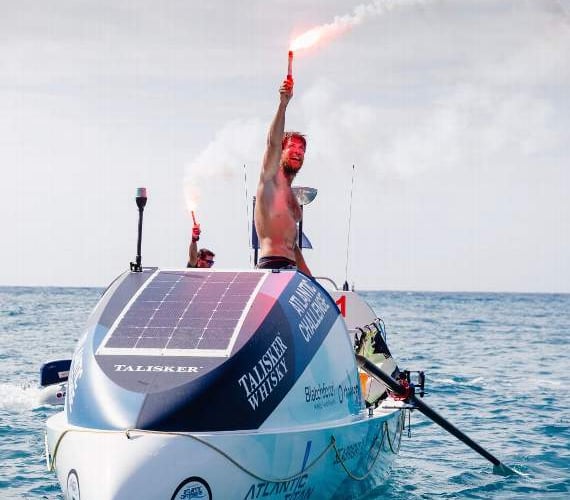
When Haslemere’s Rob Hamilton turned the corner into English Harbour, Antigua, on Wednesday last week, he couldn’t believe the sight and sounds that greeted him.
As his tiny rowing boat came into view, having just completed an extraordinary 53-day, near 3,000-mile solo row across the Atlantic Ocean, the idyllic Caribbean island burst into a riot of horns, klaxons, cheers and flags.
“What’s going on?” the astonished 30-year-old ex-Haslemere Heights schoolboy asked the nearest Talisker Whisky Atlantic Challenge safety officer. “They’re all here for you!” came the reply.
Minutes later, Rob was standing, wobbly-legged, on the jetty and back on firm land at last – one of eight solo rowers, and 21 boats, to complete this year’s race from the Canary Islands.



The Herald caught up with the local adventurer just 24 hours later...
Rob, congratulations! Are you glad to be back on firm footing?
“I am – I’m a bit firmer on my feet today than I was yesterday, anyway! I was a bit wobbly getting off the boat and looked like a complete drunk.”
So how are you feeling? Are the muscles aching?
“In the last 500 miles you have to keep telling yourself to keep focused, because 500 miles to go is a huge milestone, and it feels like you are nearly there. But it’s still 500 miles, and that’s still a long way.
“You’re like, ‘look, I need to keep it together physically and mentally. Because if I fall apart now, it’s going to take forever to get there. So keep doing what you’re doing, keep working hard, day in, day out, and you will get there – and you don’t let yourself fall apart until you get to the finish line’.
“Since I’ve got here, the soreness has starting to set in – my hip flexors, hamstrings, things like that, have started to ache.
“But to be honest, I’m quite pleased with how I’ve held up. Nothing’s that painful. There were no major injuries.”
The greatest question of all is why? How on earth did you find yourself alone on a rowing boat in the middle of the Atlantic?
“The short answer is I just really love adventures. Twelve years ago, I was at the Southampton Boat Show and I saw, among all these amazing super yachts and tall ships, this weird little looking thing. I went over to these two guys standing next to it, and they told me they were going to row across an ocean.
“I just thought that’s the coolest adventure I can possibly think of, and I’ve got to do it one day. And then that was compounded by being told I was medically unfit for the Army after – it was discovered, just eight days after starting at Sandhurst, that part of my femur was dead.
“It was then I thought, ‘Okay, now I really have to do this thing and I’m going do it solo to prove I still can do these big adventures’.
“I might be medically unfit for the Army but I’m medically fit for solo rowing across the Atlantic. That’s not bad!”
Did you have many hairy moments along the way?
“There were a few. I didn’t actually capsize, but there were some close calls. I nearly pitch-poled, which is where the stern gets thrown up into the air and goes over the bow. It didn’t quite do enough to throw me over, although it got close.
“But the hardest moments, to be honest, were the flat, calm seas. You might think that sounds idyllic, and I’m sure it is if you’re not rowing. But there’s no shade, no current, no waves – just the constant monotony of having to row day in, day out, with no wind to take the edge off the heat at all. It is absolutely savage.
“We had that for ten days or so at the start. And that was just a killer. You want a bit of weather, and when a squall blew through it was actually quite fun.
“All of a sudden you’ve got waves , wind, a bit of rain after a hot day – it is quite nice.”
It’s a huge physical feat of endurance, but I bet there’s an awful lot going on in your head...
“Oh, yeah. It’s much more of a mental challenge than it is a physical one. It helps to be fit and healthy, but it doesn’t matter how fit you are if you’re not able to deal with it mentally.
“On the calm seas I found it so tough and so hard going. It just completely broke me, basically – the first of several mental breakdowns!”
Was there a particular thought that kept you going?
“There’s that constant idea that ‘you haven’t got this far just to get this far’. But you almost have no choice. You know you can do it, that it’s possible because other people have done it, so why not you? All you have to do is just keep going a little bit further every day.
“You don’t look at it as one 3,000-mile row, you break it down to shifts on the oars, and enjoy the little things, little treats like snacks and swims. Then it becomes a lot more manageable.”
What did you miss most?
“Food. Real food. The snacks and meals I took were actually pretty good. My brother James made all my jerky, supplied by Seabright’s butchers in Haslemere who very kindly sponsored me, and it was delicious. But there’s only so much jerky you can eat!
“After 53 days, you just want something else – some hot food, a shower and a bed. And to not be constantly covered in salt water!”
What was the first thing you did when you got back to land?
“It’s a such a whirlwind. After 53 days, you don’t realise how used to being alone you get. And then when you come around the corner into the harbour and see all these people, all cheering and the yacht horns and klaxons are going off, and everyone’s going crazy.
“It was completely overwhelming and emotional.
“I asked one of the guys from the support yacht ‘what’s going on, what are all these people doing here?’
“And when he told me they were all here for me, I just thought ‘no, that’s not possible, I’m just an idiot in a little rowing boat!’
“It’s a complete blur. You moor up, a couple of the safety officers help you take your first very wobbly step off the boat, you’re rushed over to a podium for an interview with the race organiser, and then you’re ushered off into an empty restaurant and given a burger and fries.
“I’ve got to tell you, that was a pretty amazing meal – the first of a few meals that night!”
You’re no stranger to adventure, but is this the hardest thing you’ve done?
“Oh, yeah. They say in the promo videos this is a life-changing adventure, and it’s no exaggeration. I definitely feel like a slightly different person now. It seems like 1,000 years have passed since I set off.
“But at the same time it does seem this sort of adventure, to me at least, is everything that life should be about. It’s about throwing yourself into the unknown and overcoming seemingly insurmountable challenges, and just experiencing the absolute beauty of everything that’s around you. The insane night sky, the sunsets, the sunrises, swimming with dolphins, whales. But the hardships as well, the constant grind, the soreness, the extreme tiredness, the hallucinations.
“It’s the highs and the lows, and throwing yourself into that and the feeling of achievement of overcoming all of that is really what it’s all about. What it should all be about.”
You’ve got three weeks in Antigua to soak it all up, but what next?
“There are worse places! But the next thing is to get a job. I had to quit my job to do this, so I need to find some sort of work. But there’s still plenty of things I’d like to do. I’m a big-time diver, so I’d like to spend some more time working on some of my dive certifications, and I’d love to get my private pilot’s licence.
“But right now, my biggest life decision really is what to have for lunch – and that’s just about as complicated as I want my life to be for the next few days.”
* Rob took on his Atlantic row in aid of two charities: the Invictus Games Foundation supporting injured service personnel through sport, and the Collateral Repair Project, a refugee support organisation based in Jordan for whom he has previously worked.
He has to date raised more than £10,000 for these causes, and is still accepting donations online at https://www.justgiving.com/crowdfunding/atlantic-titan
Comments
This article has no comments yet. Be the first to leave a comment.