
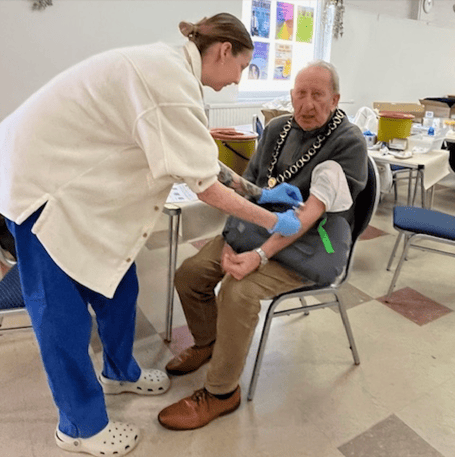
Alton Lions Club joined forces with the Prostate Cancer Support Organisation (PCaSO) to hold a fifth free PSA prostate cancer testing event.
A record number of 382 men took the blood test at Alton Community Centre on March 21, with 16 more than last year given the red flag and advised to see their GP urgently.
This was partly because more men took the test this year and the PCaSO was using different criteria to determine the risk.
The PCaSO charity is for men diagnosed with prostate cancer, and managed by men previously diagnosed with prostate cancer, Lions, supporters and professional phlebotomists.



East Hampshire District Council chairman Cllr Graham Hill took a test and opened the session, accompanied by Alton Lions Club president Paul Taroni and event co-ordinator Peter Weir of the PCaSO Hampshire branch.
The council waived car parking charges for PCaSO volunteers and phlebotomists.
Paying tribute to Peter Weir and his PCaSO team for running “an extremely well-oiled operation”, Paul Taroni thanked all the volunteers, Alton Community Centre, and Alton district councillors Elizabeth Marshall and Warren Moore for a combined community grant of £1,000.
While money from Alton Lions Club and the PCaSO ensured testing was free to participants, each test cost £15. Many tested gave donations to support the event.
PSA stands for prostate-specific antigen. The blood test measures the level of a protein produced by the prostate gland.
Elevated levels can indicate prostate conditions such as inflammation - prostatitis - an enlarged prostate or prostate cancer. The test is primarily used to screen for or monitor prostate cancer.
The 382 men aged between 40 and 80 who were tested represented a 22 per cent increase on the 313 tested last year.
Of those, 319 received a green flag for a low PSA score. The 20 with amber flags were asked to have a follow-up test in three months’ time and to consider seeing their GP. The 43 with red flags, told to see their GP urgently, was up 59 per cent on last year’s 27.
Mr Weir said: “Up until the end of 2025 we were using the National Institute for Health and Care Excellence guidelines for PSA results. Unfortunately these guidelines were for men who had some symptoms of prostate cancer.
“We then changed to the Prostate Cancer Risk Management Programme guidelines, which recommend a slightly lower level for PSA referrals and are aimed at men with no symptoms. As most of the men we test do not have symptoms we decided to use these guidelines, thus increasing the number of reds.
“Although the Prostate Cancer Risk Management Programme guidelines should have been sent to all GPs, many do not accept them and will only use the National Institute for Health and Care Excellence guidelines, causing much confusion.
“The problem of deciding what is a significant raised PSA will not be resolved for many years yet, and of course there are always a small number of men who will have prostate cancer and a 'normal' PSA.”
For more information about PSA testing visit pcaso.org
Comments
This article has no comments yet. Be the first to leave a comment.