
THE need for a bus service to serve Alton’s Manor and Wootey estates was clearly evident at a public meeting on Monday, with a packed house demonstrating a determination to break out of what, for some, is enforced isolation, by claiming back the right to access facilities and services within the town in which they live.
In a meeting of Alton Eastbrooke and Wootey Residents’ Association, attended by Community First chief executive Tim Houghton, headed by Alton mayor Derek Gardner and co-hosted by fellow ward councillors Graham Titterington (town) and Robert Saunders (district), the message was clear: if they want Community First to help, residents must be prepared to put their full weight behind the campaign for a community solution to their bus problem.
And this they can do by taking part in a public survey to ascertain the level and type of service required and to spread the word so that those most affected by the lack of bus service, who might otherwise be housebound or who may not have access to the internet, are included with a view to acquiring a service that meets local need, which everybody uses.
People are also needed to come forward to sit on a steering committee, to help with fundraising and even to volunteer, with training, to drive a community bus.




While not wishing to raise expectation, Mr Houghton said that while Community First had buses available, the first stage was to provide enough evidence to prove a demonstrable gap in service provision, so that funding could then be sought to address the problem.
It became clear at the meeting that with no bus service in the early mornings, on weekday afternoons or at the weekends and on public holidays, residents without their own transport or who are unable to drive are struggling to access basic needs.
The elderly, people with mobility issues and families with young children are virtually cut off from health and community services, from shops and social activities - and it is all for the want of a comprehensive public bus service.
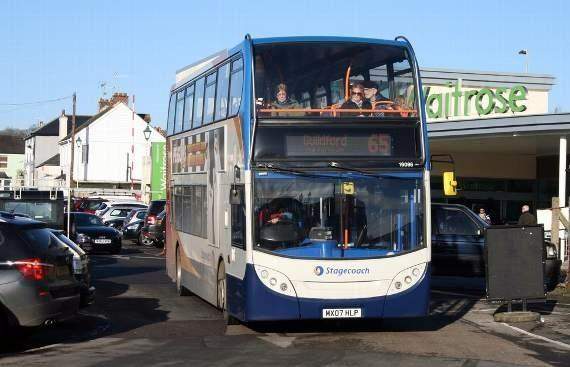
Within the last year, people living at the eastern end of town have seen the withdrawal by Stagecoach of both the No65 and the No38 town centre bus routes, to be replaced by a new No9 service, which only operates for two hours Monday to Friday, offering four round trips between 10am and noon.
For those without cars it leaves less than two hours to shop and access facilities and services, with many at the meeting saying they used the bus to get into town but had to rely on often expensive taxi services to get home.
Two hours, they said, was not enough time to visit the GP surgery or to get to the sports centre and, if they had to catch a further bus to Basingstoke hospital, getting home was a nightmare.
For Stagecoach, the change to its provision at the eastern end of town was based on a commercial decision to free up time for the No65 to meet its timetabled schedule between Alton and Guildford, while the removal of the Nursery Road/Edward Road loop, undertaken by the No 38 service, was linked to the change in Alton College’s opening hours.
Following pressure, Stagecoach agreed to spare the No9 for two hours during the week to serve what is described as “one of the most deprived areas of East Hampshire” but felt unable to offer more as “income was low from the town”.
The news came as a real blow to residents who, with a one-and-a-half mile walk into town - unachievable for many - have been struggling to cope.
On Monday, Mr Houghton gave a glimmer of hope that, if given support from residents, a community service might be achievable. He stressed that, while not a commercial bus company, Community First did have the capability and the capacity to help plug the public transport gaps but, as a non-profit-making organisation it did have to cover its costs and operate safely and within the law.
Community First has around 60 fully accessible vehicles and delivers group hire and semi-scheduled services, including Dial-a-Ride and Call & Go services across East Hampshire, including a Tuesday service in Alton.
He thought that a semi-scheduled service might be the answer for the Manor and Wootey estates but the first step was to form a steering group and to carry out a survey to establish what kind of service the community requires.
There was a need to establish links with local groups who might help with volunteering and fundraising, and with other community transport operators, with a view to sharing resources.
Also to link up with facilities in the town such as the sports centre and new developers who might have a need for a community transport link.
Commenting after the meeting, Robert Saunders reflected the view of fellow councillors, saying: “The level of attendance, with standing-room only, demonstrated the devastating effects the recent bus cuts have had on loneliness and isolation.
“I am confident that working in conjunction with Community First we can find a solution.”
Comments
This article has no comments yet. Be the first to leave a comment.