
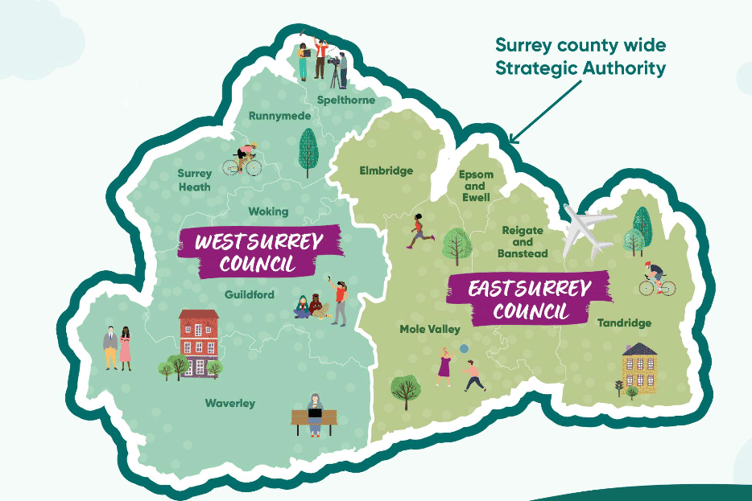
Will West Surrey Council do better?
It is sad, but quite understandable, that your paper has recently given so much column space to local frustrations arising from the poor execution of Farnham’s “improvements”.
Most recently, we have seen abusive public confrontations resulting from the pitiful management of Farnham’s pedestrianisation. And who on earth failed to check that the supply of paving slabs might be inadequate?
On another day last week, I and a large number of other drivers were inconvenienced when Waverley Lane was summarily closed at Waverley Abbey, apparently for major tree and hedge removal, requiring a substantial detour on the approach to town.




This particular roadside clearance, in a location bordering an Area of Outstanding Natural Beauty, has been widely condemned as needlessly overenthusiastic, and you report that the buck has been passed to Waverley’s planners.
However, worse is yet to come when Waverley Lane — Farnham’s arterial route south-east — will be closed again for an indefinite period to connect water supplies and sewerage for the new development spanning the road on both sides.
Many will recall the effect on the town in 2023 when West Street was closed at Coxbridge for six months for a similar purpose. In that case, the economic damage to town businesses was assessed, but no compensation was sought by the council from either the developers or the water company, which inexplicably prolonged the closure through its inability to locate its own water mains.
More recently, before the angry scenes at the foot of Castle Street, we endured a prolonged six-month closure of Downing Street during Stage 1 of the Farnham Infrastructure Programme (FIP).
This delivered wider pavements and street-level planters — a nice idea until they proved to be trip hazards for the elderly and efficient collectors of wind-blown litter, before being trashed by frustrated motorists and delivery vehicles. They are now being replaced by more robust, higher-level floral planters, similar to those originally removed.
One wonders how such projects can be managed by councillors who work nobly, but only as gifted amateurs in their spare time, unpaid it seems and on expenses, and accountable to no one except voters every 4 years, and ultimately central government. Moreover, it appears their salaried, full-time council officers are more adept at passing the buck than communicating between departments.
I wonder whether the opportunity has now arrived, with the new unitary councils we are about to elect, for a different way in which special projects — and indeed less glamorous but equally pressing routine initiatives — are organised and managed. The FIP may be an example.
As I understand it, the FIP is managed by a consortium led by Surrey County Council, with support from Waverley Borough Council and Farnham Town Council. None of these bodies is accountable to anyone except a changing electorate every four years, and ultimately to central government, which seems likely to intervene only when something goes badly wrong — as when Woking Borough Council lost a fortune on property speculation and effectively went bankrupt with debts of more than £2.5 billion.
Although councils are, I believe, subject to annual external audit, I find it hard to understand how Woking Borough Council was allowed to sail on serenely with what was clearly a disaster in progress.
It is timely now, with the forthcoming unitary council and its slimmed-down organisation, to consider how initiatives such as the FIP might be better managed. In any normal enterprise responsible for spending large amounts of investor or taxpayer money, every major project would have some form of project management — whether in-house or through a professional contractor.
The FIP should certainly have had one. The Woolmead site rescue plan perhaps another. Even Farnham’s potholes might qualify as a persistent and costly problem.
Most certainly, Woking Borough Council’s failed property speculation — for which I fear we may yet all pay as part of the future West Surrey Council — should never have proceeded without professional and accountable oversight.
As I understand it, the forthcoming unitary council will be a slimmed-down corporate structure relying more on clearly defined responsibilities — and, presumably, accountability — and much less on gifted and willing but unskilled amateurs working part-time.
This should give the new council the opportunity to focus spending — and bought-in expertise where needed — on specific short-term issues such as planning developments, the FIP, or the rescue of sites such as Woolmead, as well as on ongoing threats such as environmental damage and fly-tipping. It may even allow progress on long-standing problems such as potholes and, if we can afford it, a solution to the persistent - and now 70-year-old - traffic issues at Hickley’s Corner and the railway level crossing, now compounded by the Waverley Lane development.
One final comment on potholes: while some recent temporary repairs appear to be holding up — possibly even until the next frosts — was there really someone who calculated that it might be cheaper to pay compensation for damaged vehicles than to fix the roads properly?
I am sure there are countless things local government gets right. However, it is sad that only traffic, development and environmental issues tend to reach the headlines. I have happily been a Farnham resident for 50 years and have worked overseas in many places, but it is disappointing that the recurring local issues now feel more typical of countries of a very different kind - some at war, or even run by bandits.
I look forward to the new beginnings of the West Surrey Council.
Dr Clarence Eng,
Aveley Lane,
Farnham
Bright idea for new homes
I’ve been looking at the roofs of new houses being built in our area and wondering: where are the solar panels?
The large development near Coxbridge Farm on the edge of Farnham is a current example, with masses of south-facing roofs.
It is abundantly evident that thousands of new homes in this area demonstrate a woeful lack of responsible design by housing developers, leaving people reliant on ever-depleting, increasingly scarce fossil fuels to power their homes — and saddling occupiers with high domestic energy costs into the future.
All this while there is a big ball of fire in the sky providing free heat, and masses of relatively inexpensive solar panels available for developers to incorporate into new roofs, enabling households to power their homes for a fraction of the cost of oil and gas.
So why aren’t all new houses being built with solar photovoltaic panels as standard, for the benefit of those who will live in them? Are ground source heat pumps being designed into the infrastructure of new developments?
Why are developers so slow to respond to what is now a decades-old problem, continuing to prop up the fossil fuel market?
Let us remember that in 2006, then chancellor Gordon Brown introduced plans to ensure all new homes would be carbon zero by 2016. Imagine the positive difference that would have made to our country, our health, air quality, wider environment and household finances.
Instead, that initiative was scrapped by the Conservative government in 2015.
So here we are, with new buyers still being subjected to ever-increasing energy bills — entirely predictable and deeply irresponsible on the part of successive governments, a lack of vision from local authorities and planners, and poor design choices by housing developers, all of whom have failed to ensure robust policy is maintained on this issue.
The UK already has exceptionally expensive electricity. If households must rely on the national grid to run air source heat pumps and charge electric vehicles, bills will rise even further unless homes can generate their own energy.
Surely it is time people were better served by developers, planning authorities and governments, with higher standards firmly embedded across all new builds.
Given the known harms of fossil fuel extraction, it is incumbent on those with influence to show responsible leadership and refuse to perpetuate dependence on oil and gas when alternatives are readily available.
As a society, we should insist on better from developers and ensure all new homes are built fit for the present from the outset, rather than passing the burden on and leaving future residents with avoidable high energy bills and costly retrofitting.
Yours sincerely, Fiona Scimone
Comments
We've recently changed our login process. If you have an account for commenting, you will need to re-register on the login window.
This article has no comments yet. Be the first to leave a comment.