
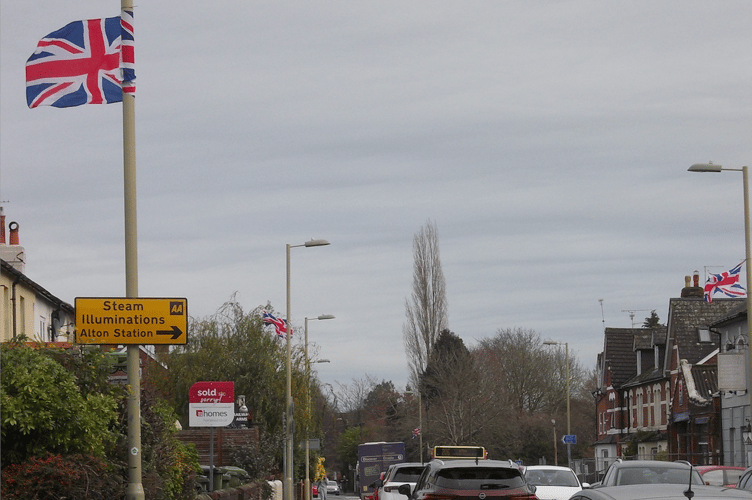
Across Britain, a quiet but powerful shift is taking place. People are rediscovering the meaning of our national symbols — and here in Hampshire, the St George’s Cross and the Union Jack are once again being flown proudly from homes, gardens, businesses and community spaces.
This is not because anyone has told them to do so, but because ordinary people are taking ownership of their identity. For too long, a vocal minority has tried to paint these flags as symbols that “belong” to certain groups or carry divisive connotations.
That narrative has never reflected the truth. In reality, these flags represent all of us, everyone who contributes to this country, benefits from its freedoms and helps shape its future.
The English flag, the St George’s Cross, should never be something people feel hesitant to display. It is a mark of belonging — a shared heritage built by generations of people from every background, belief and walk of life. The same is true of the Union Jack, which reflects the collective strength of the nations that make up the United Kingdom.


Flying these flags is not a political act. It is a simple statement: we are proud of where we live, and we are proud of who we are together.
Of course, some will still argue that the sight of our national flags is “provocative”. But we must be honest: how can anyone reject symbols that represent the freedoms, protections and community life that this country provides? A discomfort with the St George’s Cross or the Union Jack often exposes something deeper, an unwillingness to acknowledge the foundations of the country we live in and benefit from every single day.
Showing respect for the flag is not blind patriotism; it is simply an acknowledgement of shared identity and shared fortune.
A confident, unified country requires a confident, unified identity. National pride should not be something whispered or hidden away, it should be something celebrated.
Encouraging people to take pride in where they live strengthens communities, builds cohesion and deepens the sense of belonging that every society depends on. If people are flying these flags with no official campaign, imagine the unity that could be fostered if the government actively supported that pride instead of avoiding it.
What is happening across Hampshire is not a public relations exercise or government messaging. It is a genuine, grassroots revival of civic identity. People are choosing to fly the St George’s Cross and the Union Jack because they feel connected to them, because they represent home.
These flags are appearing with renewed meaning: not as symbols of division, but as markers of community, confidence and shared belonging.
If we want a stronger future, we must embrace a simple truth: national pride is not the enemy of inclusivity, it is the foundation of it. Flying our flags proudly is not an act of division. It is an act of unity — a declaration that, regardless of background or belief, we share more than we differ.
In an increasingly uncertain world, that shared identity is something worth defending — and worth flying high.
Tony James,
Borovere Gardens,
Alton
Claims over High Court ruling were misleading
The press release issued by the Liberal Democrats last week claiming that “the High Court backs Waverley’s position on Community Infrastructure Levy” is wholly inaccurate and deeply misleading. Worse, it risks politicising the grief of families already affected by these cases.
Councillors, and readers, should note the following.
First, there is no mention of Waverley Borough Council anywhere in the High Court judgment Luck v Bracknell Forest.
Second, the ruling concerns a very specific set of circumstances: a self-build new home was granted CIL exemption, then sold within the clawback period without the property being completed or lived in. Liability arose because of a clearly defined “disqualifying event”.
Third, while Mrs Justice Lieven makes several references to “discretion” in her judgment, we are informed that her remarks on whether Regulation 65(7) grants discretion are strictly obiter. In legal terms, this means they were not necessary to the decision reached and do not constitute a binding ruling or set any precedent. They are observations, not determinations.
Against that background, the Liberal Democrats’ claim that “this ruling should finally put an end to the confusion” is incorrect. The judgment relates to a specific disqualifying event, not to the wider question of whether councils have discretion.
Similarly, the assertion that “the Court has confirmed that Waverley has acted entirely within the law” is wrong. The case confirms that Bracknell Forest acted lawfully in applying CIL to an incomplete self-build home sold within the clawback period. It does not validate Waverley’s actions.
These statements should be withdrawn and corrected immediately. In future, all councillors should show greater care, respect and kindness towards families who have already endured significant distress, some of whom have been left with no option but to sell their homes.
CIL Injustice Group,
Names and addresses provided
Think of the caged hens this Christmas
If you or a loved one are enjoying a chocolate advent calendar this Christmas, take a moment to look at its size. Shockingly, around a third of the UK’s egg-laying hens spend most of their lives in cages that give each bird even less space than that - roughly the size of a sheet of A4 paper.
The good news is that shoppers are increasingly choosing to avoid eggs from caged birds. Thanks to this shift, around 70 percent of hens now live on RSPCA Assured-certified farms, managed by dedicated farmers following hundreds of strict higher welfare standards.
If you haven’t already done so, one of the easiest ways to support higher welfare farming is by switching to eggs with the RSPCA Assured label. This ensures your eggs come from hens that are free to move, stretch their wings, perch, and forage whether they are kept indoors or out.
So when you’re doing your festive shopping this year, please look for the RSPCA Assured label on your eggs and help give more hens a cage-free Christmas.
Charlotte Thomas,
Regional Assessment Manager,
RSPCA Assured
Comments
This article has no comments yet. Be the first to leave a comment.