
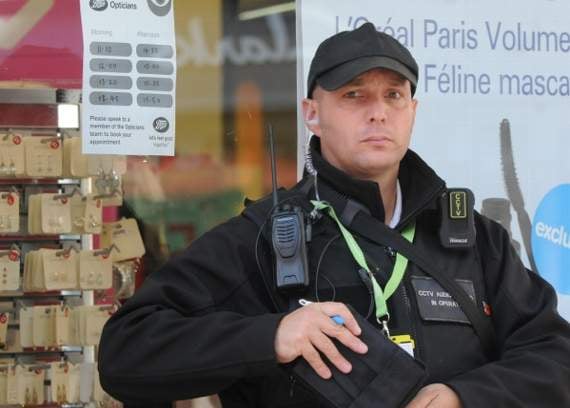
EAST Hampshire District Council (EHDC) has this week reinforced its zero-tolerance approach to litter, following an episode of BBC One’s Panorama which exposed controversial incentives for some so-called “litter police”.
In the last few weeks, EHDC has outsourced its own “litter enforcement” to other authorities – currently Havant Borough Council, Hart District Council and Arun District Council.
The practice involves litter-enforcement officers – men or women in security-style uniforms equipped with body-worn cameras – catching people red handed. They stalk their prey in public places, surreptitiously filming acts of littering as they unfold. Once their target has dropped an item considered to be litter, they strike, confronting them and issuing an on-the-spot fine of £75.
With video evidence and the threat of further legal proceedings, those caught in the act generally conclude it’s easier to just pay up. The black, authoritarian uniform probably helps too.




The BBC highlighted more controversial versions of the practice, investigating one firm, Kingdom Services, which allegedly offers employees bonus incentives for catching litter bugs.
Officers were filmed handing out fines for “tiny pieces of dropped orange peel and poured-away coffee”.
Under the Environmental Protection Act, littering is a crime – and this includes cigarette butts – but if you pay the fine you can avoid a criminal record.
While locally EHDC’s enforcement officers aren’t on commission schemes per se, critics of this kind of enforcement highlight that they obviously need to hand out sufficient fines to justify their existence.
However, their presence may well act as a deterrent once people understand what they’re up to and just how high the stakes are for dropping litter. But, of course, if they’re too successful on this front they would become an unnecessary expense.
An EHDC spokesman said that all funds generated are poured back into the council’s pot and ultimately benefit the tax-paying public.
He explained that litter is a “high priority” for residents and “costs councils many thousands to collect and dispose of”.
“As a result councils need to work together, in innovative ways, to tackle the problem,” he said.
“We have approached other authorities offering to run their litter enforcement services for them.
“EHDC recognised the challenges of a wholly commercial approach and culture. We set up our own company to better balance the needs of the residents, the place and the finances and we train our officers according to that ethos. Our aim is to help create a better community.
“Our scheme is run by a company which is a wholly-owned subsidiary of the council.
“The service is funded by the fines generated while any surplus is returned to the public purse and put toward environmental projects in East Hampshire.
“We tailor our service according to the requirements of the council we are working for but it’s always important to us and our clients that the officers behave respectfully and appropriately when carrying out their duties.
“We believe it is not fair that thousands of pounds are spent cleaning up after the inconsiderate few.
“Our message is always clear: if you don’t drop litter you won’t be fined.”
According to the campaign group Keep Britain Tidy, across the country the cost of clearing up litter exceeded £1bn last year and a further £1bn was spent clearing up waste.
Allison Ogden Nash, chief executive of Keep Britain Tidy, told the BBC: “Enforcement is one of the methods we can use to change people’s behaviour but it needs to be fair and it needs to have the public on our side.”
‘Panorama - Inside the Litter Police’ was aired on May 15 on BBC One and is now available to watch on BBC iPlayer.
Comments
This article has no comments yet. Be the first to leave a comment.