
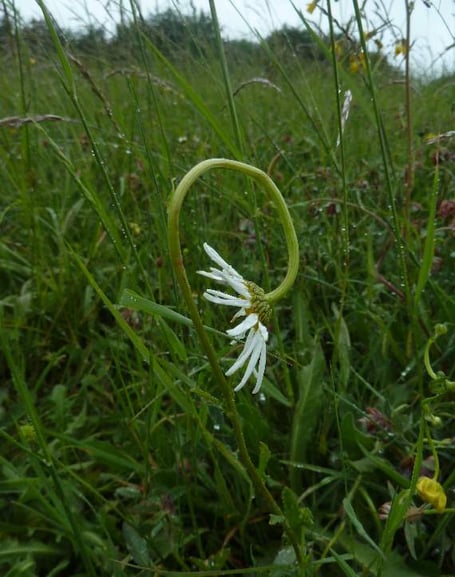
THE damage caused to flora and fauna following the spraying with herbicide of the Treloar butterfly meadow has led to heavy criticism by members of Alton Natural History Society over the management of the land.
While the Government-run Homes and Communities Agency, as the owner of the site, has given an assurance that the herbicide used was targeted at ragwort and will not affect any insects or orchids, the natural history society has joined Save Alton’s Butterfly Meadow campaigners in slating the developer for poor practice.
In seeking to emphasise the importance of preserving what she describes as “a rare habitat now in East Hampshire”, in a letter to The Herald this week, naturalist and Alton Natural History Society member Dr June Chatfield wrote: “Along with other Altonians and natural historians I am not impressed with the management of the Homes and Communities Agency on the grass slope adjacent to Ackender Wood, sloping down to Whitedown Lane.
“Historically it has been grazed by sheep, it is on chalk bedrock and the lower slope is neither covered with clay-with-flints, like the area around the water tower, nor has it been massively agriculturally improved and would have a natural dormant seed bank of genuine local wild flowers.”




The Homes and Communities Agency gained planning permission to build 280 new homes on the 28-acre site adjoining Treloar Heights in February last year, part of which will encroach on the stretch of meadowland bordering Ackender Wood. Due to its sensitive nature and in a bid not to breach the skyline, a condition of planning was imposed for 20 acres of the meadow to be given over to ‘country park’, which will eventually be handed over to Alton Town Council.
But, pointed out Dr Chatfield, while most country parks are more in the order of 400 acres plus, this is a very much smaller area and, as such, “needs specially careful management if its biodiversity and interest is to be maintained and for it to be a meaningful compensation for the loss of open space agreed to in the development of the hospital site that already has planning permission and is in the Alton Neighbourhood Plan”.
Dr Chatfield points out that much of the area’s chalk grassland has been lost to agriculture and that it is important therefore to look after the small areas remaining, such as Holybourne Down, nearby Noar Hill at Selborne, and the Treloar butterfly meadow.
Alton Natural History Society members are keen to help in this process, especially since, when working on the planning application response last year, it had been impossible to open the stage one botanical report, which appeared to be blocked.
Dr Chatfield said: “Local biologists and members of Alton Natural History Society need access to this data so that they can add the benefit of their own observations and local experiences to those of the consultants who may only visit on a single occasion and not necessarily at the most advantageous time.”
Dr Chatfield continued: “We need to know what is there in detail before rushing in with inappropriate management and to remember that there is more than one way to tackle the ragwort.
“The developers are not acting in the right spirit.”
Dr Chatfield believes there is a weakness in the conditions imposed when planning permission was granted for the site and that they should have included the words ‘the natural biodiversity of the site must not be harmed prior to official opening of the green space and advice sought from the wildlife trust’.
Alton Natural History Society is worried that “normal agricultural practice”, when applied to ragwort, can be used as a loophole for over-aggressive spraying.
Dr Chatfield said: “Although stated that the herbicide was targeted for ragwort, it has spectacularly caught out other members of the daisy family like ox-eye daisies and other yellow-flowered composites as well as non-related orchids, so appears to be a broad-range herbicide. We need to know what it was.
“When ragwort flowers (it is a great insect resource) it is conspicuous and there is not a major widespread problem. The Hampshire branch of Butterfly Conservation owns and manages meadows for butterflies and has met ragwort and tackles it sensitively by judicious pulling by volunteers.
“The Homes and Communities Agency should have gone back to the Alton community, as those familiar with the land, for guidance in helping to maintain the future open space.”
Dr Chatfield is fiercely critical, saying: “This insensitive action on the part of the Homes and Communities Agency is not good PR and shows a lack of understanding and sympathy for rural market town communities like Alton.
“We have compromised and agreed to the development of the hospital site on a scale that we would not prefer and after the pre-application consultation, when the developers should know exactly where Altonians stood on development and countryside matters, we are disappointed that they seem to have lost the plot and thus the goodwill and trust of the town.
“Any grazing on the site needs to be part and parcel of the wildlife management in view of its future and should avoid added nutrients, not seen as a total commercial exercise of tenancy but judicial use of animals for maintaining the grassland taking advice from the Hampshire Wildlife Trust, Hampshire Biodiversity Information Centre, Hampshire Butterfly Conservation, Alton Natural History Society etcetera. In other words, people who know and care.”
In firing a broadside at East Hampshire District Council planners, who have been made aware of the Alton Natural History Society’s views on the matter, Dr Chatfield concluded: “Conservation amenity grassland management is a relatively new area of practice and needs skill and sensitivity. We do not want the developers to be given an inch and then take a mile and look for better integrity in the future.”
Comments
This article has no comments yet. Be the first to leave a comment.