
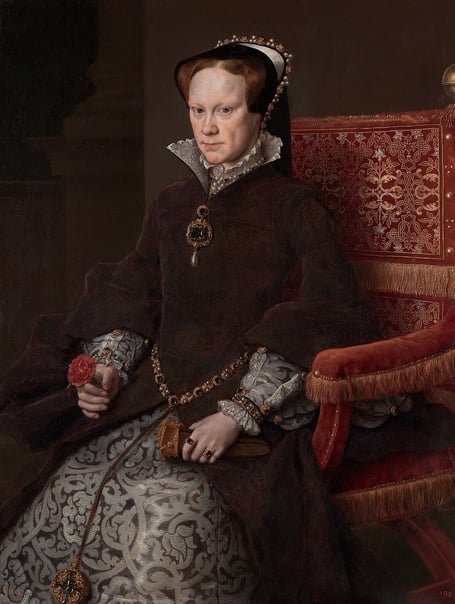
Stephen Gardiner, born around 1483, was one of the most powerful and complex figures of Tudor England. His career reached its zenith in July 1554 when, as Bishop of Winchester, he officiated at the marriage of Queen Mary I, aged 38, to Philip of Spain, the 27-year-old heir to the Spanish throne, in Winchester Cathedral.
Few towns can claim such proximity to that historic event as Farnham, where the Queen stayed in the weeks leading up to her wedding, lodging at the Bishop’s Palace under the protection of her most trusted adviser.
Mary’s decision to stay in Farnham was significant. It was here, away from the pressures of London, that she prepared for a marriage intended to secure both her throne and her faith. During her stay she hunted on horseback and received gifts of greyhounds and a hawk, but Farnham offered more than recreation. It was a place of safety at a time when Mary’s position was far from secure.
Gardiner’s appointment to the bishopric of Winchester speaks volumes about his stature. Long before his association with Mary, he had enjoyed a dazzling career under Henry VIII. Educated at Cambridge, he became secretary to Cardinal Thomas Wolsey, a role that brought him to the attention of the King and launched his diplomatic career across Europe.




Gardiner was deeply involved in Henry VIII’s “Great Matter”, travelling to France and Italy in an ultimately unsuccessful attempt to secure an annulment of the King’s marriage to Catherine of Aragon. Though he failed in that task, his learning and intellect impressed even his enemies. In 1533 he assisted Archbishop Thomas Cranmer in declaring Henry’s marriage null and void, and two years later he was among the bishops who endorsed Henry’s title as Supreme Head of the Church of England.
Readers of Hilary Mantel’s Wolf Hall trilogy, or viewers of the BBC adaptations, will recognise Gardiner as Thomas Cromwell’s great rival — a man of formidable intelligence whose ambitions collided with Cromwell’s own. Only one would survive the struggle for influence at court. Gardiner was played in the TV series by Mark Gatiss and more recently by Alex Jennings.
Despite England’s break with Rome, Gardiner remained a committed Catholic, a position that required constant manoeuvring. In 1546 he attempted, unsuccessfully, to turn Henry VIII against his Protestant wife, Catherine Parr. The plot failed, but it revealed where Gardiner’s true religious loyalties lay.
After Henry VIII’s death in 1547, Gardiner’s fortunes collapsed. Under the Protestant Edward VI he was imprisoned in the Tower of London for opposing religious reforms. His release came with the accession of Mary I in 1553. Gardiner was restored to the bishopric of Winchester, appointed Lord Chancellor — the highest office in the realm — and crowned Mary Queen of England at Westminster Abbey.
He also helped overturn the annulment of Henry VIII’s marriage to Catherine of Aragon, restoring Mary’s legitimacy. Once again, Gardiner stood at the very centre of English power.
Mary’s choice of Philip of Spain as her husband was deeply controversial. Parliament attempted to dissuade her, fearing foreign influence and loss of sovereignty. Gardiner worked tirelessly to negotiate a marriage treaty that reassured the nation. The agreement ensured Philip would not rule England independently nor involve the country in Spain’s wars.
Opposition soon hardened into rebellion. Wyatt’s Rebellion in early 1554 threatened Mary’s throne and her life. Gardiner was forewarned of the plot, allowing London to be secured and the Queen to rally support with a powerful speech at the Guildhall. When the rebels reached the capital in February, they found the City barricaded on Gardiner’s orders.
Wyatt was tried, convicted of treason and executed in April 1554. The Queen and her Bishop had prevailed.
On July 25, 1554, the marriage finally took place. Mary modelled the ceremony on that of her mother, Catherine of Aragon, in 1501. For Mary, it was a moment of hope. For Philip, it was a political obligation. Though outwardly courteous, he spent long periods away from his wife.
Mary died on November 17, 1558. Philip was abroad and, with her death, lost his title as King of England and Ireland. His reported response was restrained: “I felt a reasonable regret for her death. I shall miss her.”
Mary’s reign is remembered for its religious persecutions and bloodshed, yet her life had been shaped by forces beyond her control. Perhaps in Farnham she found a brief sense of peace — a moment away from the burdens of crown and expectation.
Stephen Gardiner died on November 12, 1555 after a period of illness. It is said that as he lay dying, the Passion was read to him and that his final words were: “Erravi cum Petro, sed non flevi cum Petro” — “Like Peter I have erred, but unlike Peter I have not wept.”
He was buried in Winchester Cathedral, in the chantry chapel that still bears his name. His death robbed Mary of her most reliable counsellor.
Known to contemporaries as “Wily Winchester”, Gardiner was admired for his intellect, courage and wit. His life and career remind us that Farnham was not merely a backdrop to history, but a place where national decisions were prepared, debated and quietly shaped — a town with a lasting, if understated, role in England’s Tudor story.
For more information about Farnham Castle Trust, visit www.farnham-castle.com
Comments
This article has no comments yet. Be the first to leave a comment.