
_-004.jpeg?width=455)
Long before Farnham was a bustling market town, its quiet palace rooms once sheltered the most precious child in the kingdom, writes Gillian David.
For nearly seven years, within the walls of the Bishop’s Palace and beside the open stretches of Farnham Park, the future hope of the Tudor dynasty was rocked to sleep, guarded and groomed for a crown that history would ultimately deny him.
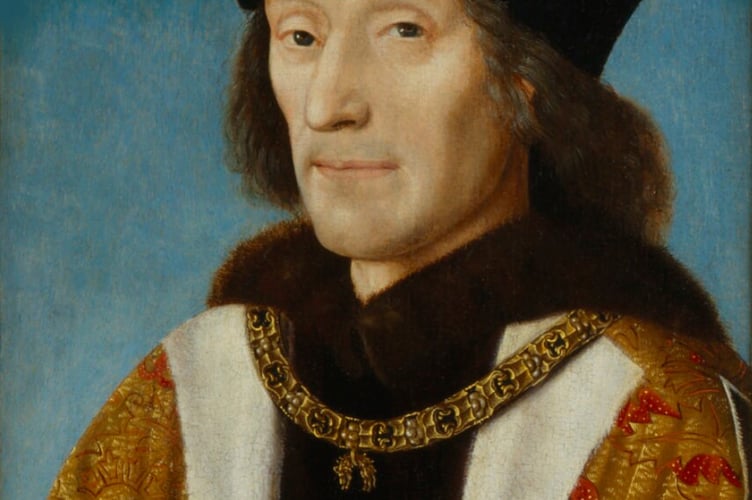
On 20 September 1486, just eight months after her marriage to Henry VII, Queen Elizabeth of York gave birth to her first child. The baby, a boy named Arthur, was hailed as a good omen for the fledgling Tudor dynasty. His birth symbolised not only the survival of Henry’s new crown but also the long-awaited union of the warring houses of Lancaster and York.




Henry chose Winchester for the birth, believing that his heir, named after the legendary King Arthur, would usher in a new “Camelot.” The christening ceremony at Winchester Cathedral was lavish, carefully orchestrated by Queen Elizabeth and her formidable mother-in-law, Margaret Beaufort.
Within a month Arthur was moved to the specially prepared royal nursery at Farnham’s Bishop’s Palace. Elizabeth Tyrell, Lady Darcy, a seasoned governess to the children of Edward IV, was appointed to oversee the household. Caroline Gibbons served as wet nurse, assisted by two “royal rockers” to keep the infant prince’s cradle in motion.
Overall supervision lay with Peter Courtnay, Bishop of Exeter, soon to be elevated to Bishop of Winchester, who had been a loyal supporter of Henry Tudor and officiated at his coronation.
Around a dozen carefully selected staff cared for Arthur. Farnham was chosen for its safety: far enough from London’s regular outbreaks of plague and potential unrest, but close to Margaret Beaufort at Woking Palace. Henry VII, wary of the fate of the Princes in the Tower, entrusted his son’s care only to those whose loyalty had been tested.
The king himself saw Arthur only four times during his almost seven years at Farnham, but the household proved so dependable that several of its members later followed him to Ludlow Castle.
In 1487 Henry ordered that 1,000 marks (£666 13s 6d) — equivalent to around half a million pounds today — be allocated to the royal nursery, about 5 percent of the king’s annual household budget. The money paid for staffing and lavish furnishings, including a feather bed and down bolster, scarlet sheets lined with ermine, a lawn coverlet embroidered with the Queen’s arms, and tapestries fitted with iron rails to keep out draughts.
As Arthur grew older, fabric was supplied to his nurses, who fashioned fine gowns and tunics of white velvet, damask, satin and ermine. These were carefully recorded by Peter Curteys, Keeper of the King’s Wardrobe.
By 1490 Arthur’s upbringing shifted towards formal education. His tutor and chaplain was John Rede, born in nearby West Worldham and a former headmaster of Winchester College.
Daily life also included training in noble pursuits. Under the watch of Richard Howell and John Almor, who oversaw his household and security, Arthur learned horsemanship, archery, hunting and the martial skills expected of a future king — no doubt practised in Farnham Park.
Arthur’s royal status was underlined early. At just three years old he was made a Knight of the Garter and invested as Prince of Wales. Marriage negotiations had already begun: in 1489 Henry secured a betrothal between Arthur and Catherine of Aragon, youngest daughter of Ferdinand and Isabella of Spain. The match promised a dowry of 200,000 crowns and, more importantly, placed the Tudors firmly among Europe’s leading monarchies.
Arthur grew up apart from his siblings. His younger brother Henry — the future Henry VIII — spent his childhood at Eltham Palace under their mother’s care, intended originally for a church career. His sister Margaret married James IV of Scotland, while Mary wed first Louis XII of France and later Charles Brandon, Duke of Suffolk. Several others — Elizabeth, Edmund and Katherine (born after Arthur's death) — all died in infancy.
In 1493 Arthur left Farnham for Ludlow Castle, seat of the Prince of Wales in the Welsh Marches. There he was tutored by Bernard André, poet laureate and humanist, another trusted supporter of Henry Tudor's claim to the English throne.
In 1501, Arthur met his bride Catherine of Aragon at Dogmersfield House, not far from Farnham, and the pair were married at St Paul’s Cathedral on 14 November 1501. But within months both fell ill at Ludlow, suffering from some sort of sweating sickness. Catherine survived; Arthur did not. He died on 2 April 1502, aged just 15, and his body was interred in Worcester Cathedral.
Arthur’s death not only ended hopes of a “new Camelot” but also set in motion a chain of events that, decades later, would bring about the English Reformation.
For a brief, hopeful chapter in England’s story, the future of the Tudor crown once rested quietly behind the walls of Farnham’s Bishop’s Palace.
For more information about the Farnham Castle Trust, visit www.farnham-castle.com
Comments
This article has no comments yet. Be the first to leave a comment.