
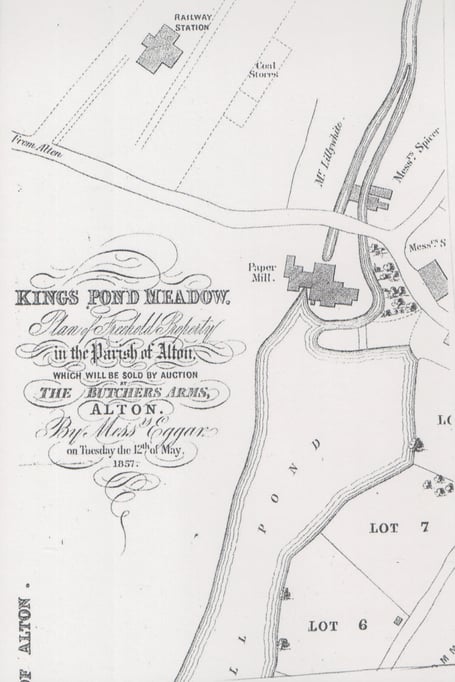
Originally, on the site of the flats at the eastern end of King’s Pond, there stood a water mill.
One had been there since at least the medieval period - and this did not have a mill pond, as when corn needed to be ground there seemed to have been a reasonable supply of water.
A document of 1743 showed that the River Wey ran right up to the mill, as Richard and Thomas Baker wanted to lay boards across it to make a bridge.
Thomas Lamport, the miller, was against the plan, and said that if they tried he would pull it down. This showed that there was still no pond at that date.




The area of the present pond was described as ‘the Moor’ or ‘Mill Moor’ in several deeds and rentals. A moor was an area of poor, often wet, soil that was no good for farming. In the south, it did not need to be high ground.
As the Lamports also had Anstey Corn Mill, they decided to add a paper mill to the Alton site and invited Kendrick Peck, a stationer of Wood Street in London, to join them in business. It seems that a second mill was then built there for paper making, next to the corn mill.
Kendrick was followed by several others, with William King arriving in the 1780s. Under him, the paper mill was enlarged and, in 1792, he bought the land known as Mill Moor.
This was presumably with the intention of damming the river and letting a pond form there, thus ensuring water would be available for the paper mill all year round.
Four years later he moved on, but with the pond named after him he is not forgotten. Sadly though, as King’s Pond is not natural, it silts up.
The Spicer family took over the paper mill and also had several cottages at the other end of the pond. These had once been Orps Mill, which was used for fulling cloth before it ceased working. The occupiers had gardens on an island nearby.
In the Victorian period, King’s Pond was a source of brown trout ova. In 1864 it was reported that, of the 3,000 loaded on to the clipper Norfolk, one-third came from King’s Pond.
These were transported to Hobart, Tasmania, in an icehouse, and of those that survived, some were used to stock the South Island of New Zealand. The pond was also used for skating in the winter. At night there would be ‘torch-light gatherings’.
Frederick Crowley of the Alton brewing family bought the land on the opposite side of Ashdell Road and erected a large house there known as Ashdell.
He then had a laundry built on the edge of the pond and a rustic bridge over the road to connect the two. One assumes that the laundry did not use the water from the pond. The rustic bridge appears in several old postcards.
In 1888 the Spicers decided to sell the mill, which was described as an “eight-vat paper mill with water power derived from a large sheet of water known as ‘The Kings Pond’ supplied by springs”. It did not reach its reserve and so was not sold.
Twenty years later though, the mill closed at very short notice. In 1913 all the machinery was sold, but the premises and King’s Pond were not put up for sale until 1919 because of the First World War.
The new owner was the Alton Battery Factory, and it fitted a motor to the water wheel before changing to diesel engines. The pond and surrounding land were bought by Alton Urban District Council after the Second World War.
The story of the mills in Alton, including the ones on the River Wey and the water mills between Alton and the Surrey border, is told in Alton’s Mills by Jane Hurst, available priced £3 (plus £1 postage) at [email protected]
Jane Hurst
Comments
We've recently changed our login process. If you have an account for commenting, you will need to re-register on the login window.
This article has no comments yet. Be the first to leave a comment.