

It's now 10 years since a statue of William Cobbett was erected in the heart of Farnham.
The anniversary has been given added poignancy by the deaths of two people who helped unveil the monument.
Dame Penelope Keith, the much-loved actress and Milford resident who unveiled the bronze sculpture in September 2016, died earlier this year, as did artist Charles Bone, whose determination ensured his late wife's creation became a permanent landmark in the town.
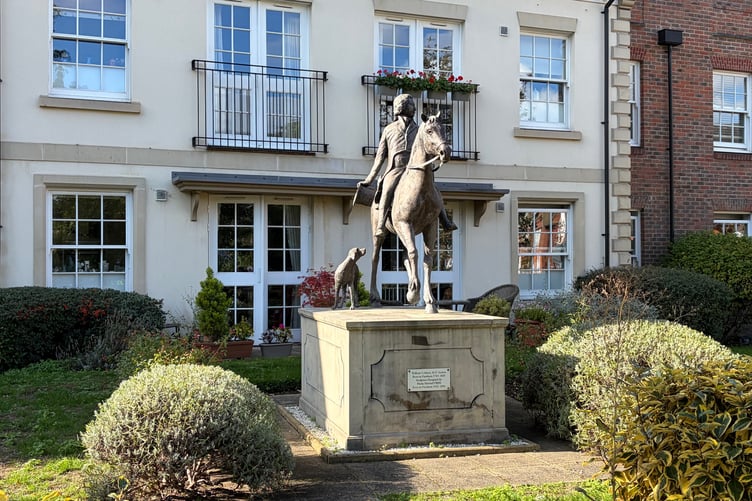
The statue depicts the Farnham-born writer and political reformer William Cobbett.
But behind the familiar figure on horseback lies the lesser-known story of another Farnham native, sculptor Sheila Mitchell, who designed the monument but died a decade before it was finally unveiled.
Her husband's campaign to fulfil her vision would take eight years, overcome disagreements about where the statue should stand and eventually raise £50,000 to bring the project to fruition.
Reporting on the unveiling in September 2016, the Farnham Herald described how sitcom star Dame Penelope invited the large crowd to count down from ten before pulling a red cover from the sculpture.
"It was a privilege for me to unveil this beautiful statue today," she said.
"I hope it will serve to highlight to the people of Farnham the life and achievements of a little known but really quite extraordinary figure in British history."
 Farnham-founded Rock Choir sings for David Attenborough at Natural History Museum
 Two teenagers on trial for alleged murder of Farnham schoolboy Luis Guembes
 ‘Virtually all our pubs have disappeared’: Warning as another Farnham local closes
 Letters to the editor: Farnham town centre junction is accident waiting happen
Dame Penelope, who lived in Milford for more than 50 years, died in June, aged 86.
Charles Bone, meanwhile, died at his Puttenham home in March, aged 99, just six months short of his 100th birthday.
An internationally respected painter, he had exhibited at the Royal Academy and held more than 50 solo exhibitions in Britain and overseas.
He was also president of the Farnham Public Art Trust and chairman of the William Cobbett Statue charity, through which he pursued his ambition to complete his wife's work.
At the unveiling, he told the Herald: "It has taken many years of hard work to get to this point, and I'm delighted to see the statue finally take pride of place in such a wonderful location at the heart of the town."
The project had not been straightforward.
In 2011, Charles proposed installing the statue in Gostrey Meadow, opposite Cobbett's birthplace, but Waverley Borough Council rejected the location amid concerns about its size and positioning.
Three years later, councillors agreed to a site at the junction of Long Bridge and Downing Street, outside Churchill Retirement Living's Hawthorn Lodge development.
The company subsequently contributed the final £10,000 needed to reach the £50,000 fundraising target.
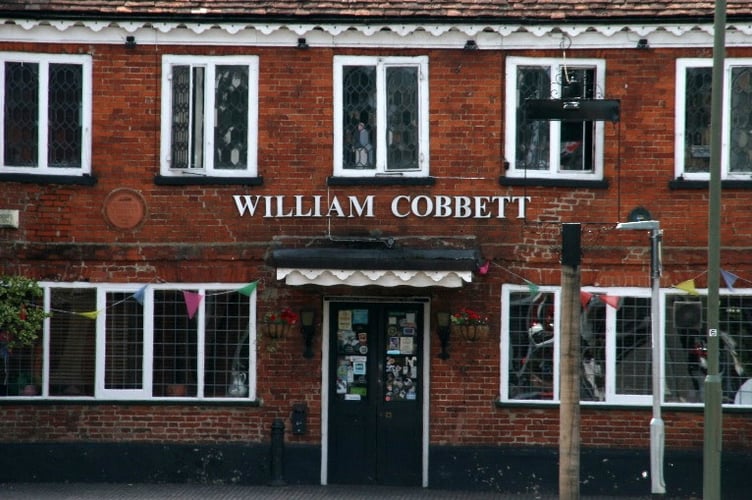
The location was fitting, close to Cobbett's birthplace and the pub bearing his name, and a short distance from his grave in St Andrew's churchyard.
Yet while Charles became the driving force behind the project, the artistic vision belonged to his wife.
Born in Farnham in November 1926, Sheila Mitchell showed exceptional talent from an early age.
She studied at Guildford School of Art before attending the Royal College of Art between 1948 and 1951, where her tutors included distinguished sculptors Frank Dobson and John Skeaping.
She had already exhibited at the Royal Academy in 1945, when she was just 18.
Sheila married Charles, a fellow Royal College of Art student, in 1951. The couple settled in Puttenham, where they established studios and pursued their artistic careers alongside one another.
She became an accomplished figurative sculptor, working principally in bronze and terracotta, and also produced ceramics for the Royal Worcester Company.
Her reputation grew through portrait commissions, with subjects including the Duchess of Kent and Olympic champion Sebastian Coe.
She produced more than 150 portrait sculptures and became a Fellow of the Royal Society of Sculptors in 1975, later serving as president of the Society of Portrait Sculptors from 1978 to 1983.
Among her final contributions to Farnham was the model of Cobbett mounted on his horse.
The choice of subject was particularly appropriate.
Born in Farnham in 1763, Cobbett was the son of a farmer and publican who rose to become one of Britain's most influential and outspoken political commentators.
He spent time in the army and lived in America before establishing himself as a journalist and campaigner, using his writing to attack political corruption and defend the interests of ordinary people.
His best-known work, Rural Rides, grew from journeys on horseback through southern England, during which he chronicled the hardships facing agricultural labourers.
Cobbett eventually entered Parliament as MP for Oldham in 1832, following the Great Reform Act, and died in 1835.
The sculpture captures him as generations of readers have imagined him: travelling through the countryside, observing the lives of the people whose cause he championed.
Sheila died in May 2006 before her design could be realised in bronze, leaving Mr Bone to carry the project forward.
A decade later, her creation finally took its place at one of Farnham's principal entrances.
And now, 10 years after that unveiling, the deaths of Charles and Dame Penelope have brought renewed significance to the landmark.
Comments
We've recently changed our login process. If you have an account for commenting, you will need to re-register on the login window.
This article has no comments yet. Be the first to leave a comment.