
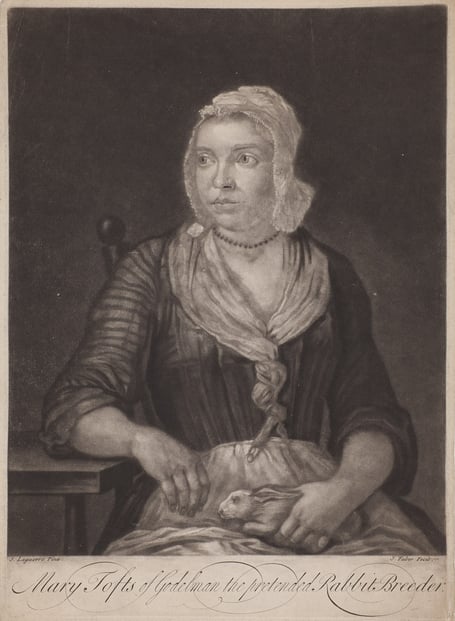
Three hundred years ago on November 14, 1726, the Daily Journal shocked its readers with the amazing news that a Surrey woman was giving birth to rabbits.
The newspaper reported that John Howard “an eminent Surgeon and Man-Midwife, living at Guildford” had already delivered nine rabbits from her.
This sensational news was reprinted in the other London newspapers, including Mist’s Weekly Journal, which sold between 8,000 and 12,000 copies each week. The news was then copied by the provincial papers as far north as the Caledonian Mercury in Edinburgh. Soon the whole nation had heard about these strange births.
Later papers provided updates, including the news that King George had sent two of his royal doctors down to Surrey to find out what was going on, and they had both delivered rabbits from the woman on separate occasions.
The bizarre story that gripped Britain
Mary Toft of Godalming was 23 years old when she gave birth to rabbits. Her husband, Joshua Toft, was a few months older than her. He was a journeyman cloth worker. Due to the depressed state of the cloth industry in the 1720s their poverty was such that, despite being pregnant and having a young child at home, Mary was working as an agricultural day labourer.
Mary told John Howard that, when she was about five weeks pregnant, she was weeding in a field when she was startled by a rabbit. She chased after the rabbit and tried to catch it.
Shortly after, another rabbit appeared, but again the rabbit got away. That night she dreamt she had the two rabbits on her lap, “and from that Time, she hath not been able to avoid thinking of Rabbits”.
The belief that a shock, or an obsession, or any other strong impression on a pregnant woman could produce a mark on a child or even alter its shape while it was being formed in the womb had been held by physicians and lay-people for centuries. This theory was known as “maternal impression”.
In 1726 it was still the most accepted explanation for abnormal births and was endorsed by the medical textbooks. The belief carried into the 19th century, as in the case of Joseph Merrick, the Elephant Man.
 BREAKING NEWS: Teenage pair found guilty of murdering Luis Guembes
 Jury retires to consider verdicts in murder trial of Farnham schoolboy Luis Guembes
 Surrey council refuses to back down over ULEZ signs despite motorists' £15m in fines
 Peeps into the Past: Congratulatory royal address for birth of heir to throne
A case of maternal impression
The news that a woman had given birth to rabbits appeared to be an, albeit extreme, example of maternal impression. Reports of Mary’s rabbit births frightened some pregnant women into wondering whether they too might be carrying strange offspring.
A few months after the incident with the two rabbits, Mary suffered a long and painful miscarriage that lasted several weeks, but on 27 September 1726 something came out of her that did not appear to be human. They called in John Howard and over several days he delivered the guts of a cat containing the backbone of an eel, three cat’s legs, one rabbit leg and a rabbit’s head from Mary.
Thereafter, Mary started giving birth to rabbits. Mary was delivering a rabbit nearly every day. Howard spent most of his time in Godalming assisting Mary with the deliveries. When he was not helping Mary give birth to rabbits, he was sending letters to “Persons of Distinction in Town” excitedly reporting news of these wondrous births, which is how the king and the newspapers got to hear about them.
After delivering Mary’s ninth rabbit, Howard moved her to Guildford because he was so busy delivering rabbits at Godalming that he was neglecting his practice at Guildford. Also, Guildford was more convenient for the important visitors from London he was hoping to attract.
Seventeen rabbits and a royal investigation
Mary’s births were the talking-point of the country, which was torn between those who believed the rabbits had been bred inside her and those who thought the whole thing was a hoax.
After she had given birth to 17 rabbits, the king ordered his doctors to bring her to London where, “great Numbers of the Nobility have been to see her and many Physicians have attended her, in order to make a strict Search into the Affair”.
After spending nine days in London being watched 24/7 and being threatened with a painful operation as she appeared to be made differently from other women, Mary finally admitted she had been inserting rabbits into herself and allowing them to be removed as if she was giving birth.
Mary was sent to prison to await trial where vast crowds flocked to see her, but after four months she was released without charge as there was no law against women giving birth to rabbits.
The hoax that humiliated the doctors
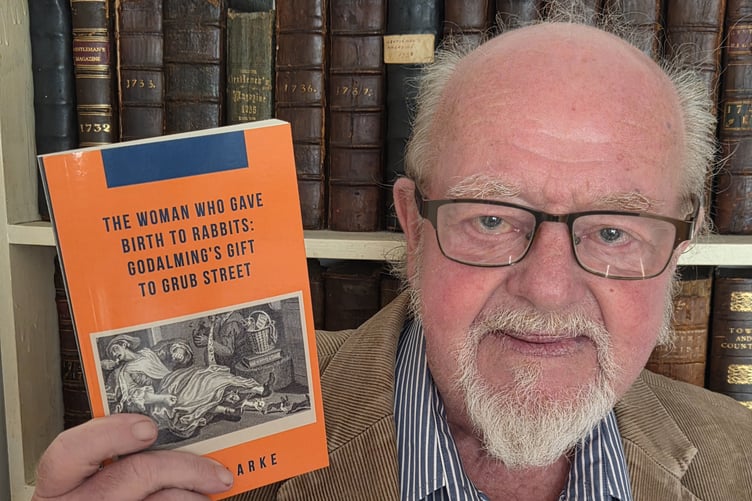
Bob Clarke, author of the recently published book, The Woman who Gave Birth to Rabbits: Godalming’s Gift to Grub Street, said, “Until Mary’s confession, none of the many doctors who were involved in her case declared publicly that they thought it was a hoax.
“Once she confessed, the doctors scrambled over each other in a race to publish pamphlets trying to protect their reputations, claiming they knew it was a hoax all along but had kept quiet for various reasons.
“Mary’s births were the media sensation of 1726. Apart from the doctors’ self-serving pamphlets and the several months of sensational material in the newspapers, they kept the Grub Street presses busy entertaining the public with a flood of pamphlets, caricatures, ribald ballads and satires.
“Some used Mary’s story as an opportunity for bawdy humour. Some reflected the conflict between traditional midwives and men-midwives, while others sprang from resentment about the Hanoverian king’s preference for German-speaking physicians and courtiers.
“But most of them delighted in the tale of an illiterate country girl who outwitted the doctors and made them look a bunch of gullible fools.”
Comments
We've recently changed our login process. If you have an account for commenting, you will need to re-register on the login window.
This article has no comments yet. Be the first to leave a comment.