
An ongoing mission to find and commemorate the places that played a part in Spitfire production has led a charity to an historic home and hotel in East Hampshire.
Ninety years ago this month the first Vickers Supermarine Spitfire took to the skies above southern England.
And we all know what happened next, with the legendary plane becoming part of the nation’s heritage thanks to its key role in the Battle of Britain.
But while we all remember Churchill’s famous quote about so much owed by so many, to so few, less has been said about “unknown warriors” that kept up production in the most desperate at times.


Some of those were remembered on March 15 when a plaque commemorating the role that Langrish played in Spitfire production and the war effort was unveiled at the historic property and hotel near Petersfield.
The plaque at Langrish House was the 21st to be commissioned by the Southampton-based Spitfire Makers Charitable Trust with their chair, Alan Matlock, explaining the importance of the unveiling.
He said: “It’s out mission to local and commemorate those places in Hampshire which were responsible for ensuring that Spitfires were built after the bombing of the Supermarine factory in Southampton.
“Churchill said there are vast numbers, not only in this island but in every land, who will render faithful service in this war, but whose deeds will never recorded, and whose names will never be known.
“It was a war of the unknown warriors.”
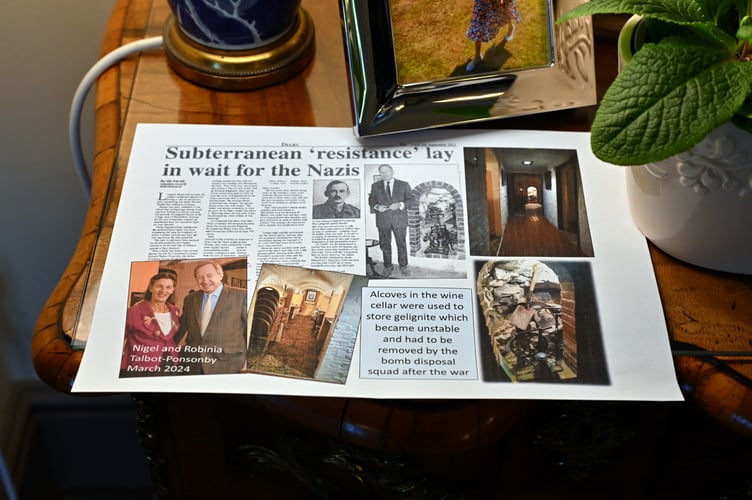
It’s fairy well known Langrish House played its part in the war effort. It was taken over by New Zealand troops while it was also a headquarters for a secret resistance force whose members were called “Scallywags”.
But while their secret members prepared for invasion on the ground, people in the stable blocks next door to the house had their eyes on the sky.
Edward Talbot-Ponsonby, father of the house’s current owner, Nigel, set up a small engineering company in the 1930s called Talbot-Ponsonby & Co Ltd that specialised in making diecast and mould-making precision tools.
That precision caught the eye of Supermarine and they were sub-contracted to manufacture Spitfire parts and munitions.
The words ‘made in Langrish’ were lovingly written on each bomb with up to 160 men and women involved in 24-hour production at the village site.
Mr Matlock believes there were 300 sub-contractors nationwide with places like Britnell & Crawter and Norman Fox & Co of Petersfield, both subsidiaries of Wadhams, being similarly involved.
Around 50 people attended the private unveiling with guests including Petersfield mayor, Cllr Chris Paige, who took part in the big reveal with Mr Talbot-Ponsonby.
Some of the guests had relatives who worked in the Langrish stable block. Philip Stoneham knew his mother, Dorothy, was one of the “unknown warriors” while some remember the bombs that fell close to the hotel and on East Meon during the conflict, with the latter possibly mistaken for HMS Mercury.
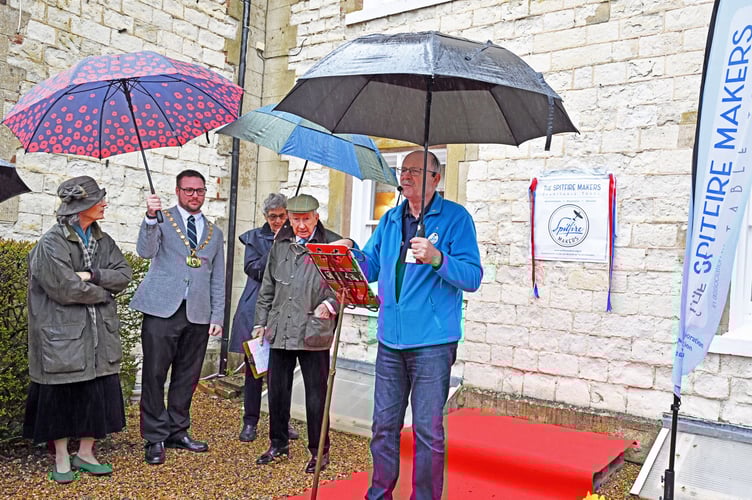
Nigel Talbot-Ponsonby is certainly proud of the role his father and the house played in the conflict, finishing his speech with a cry of “Thank Goodness for the Battle of Britain and the Spitfire”.
He said: “We’re here to commemorate the vital role played by the men and women of Langrish – It’s all part of the nation’s heritage, part of the nation’s history.
“This house was a headquarters for Churchill’s secret resistance force, tasked with opposing to be an inevitable German invasion at the time – but what the enemy hadn’t reckoned on was the Spitfire.”
Mr Matlock also named seven of the Scallywags, before recalling Churchill once more.
“He said that the front line runs through the factories – the workmen are soldiers with different weapons, but have the same courage,” said Mr Matlock.
“We know that some of these workers, certainly the ones in Southampton, were committed to doing their bit, but so too were the men and women, working right here in Langrish.”
Comments
This article has no comments yet. Be the first to leave a comment.