
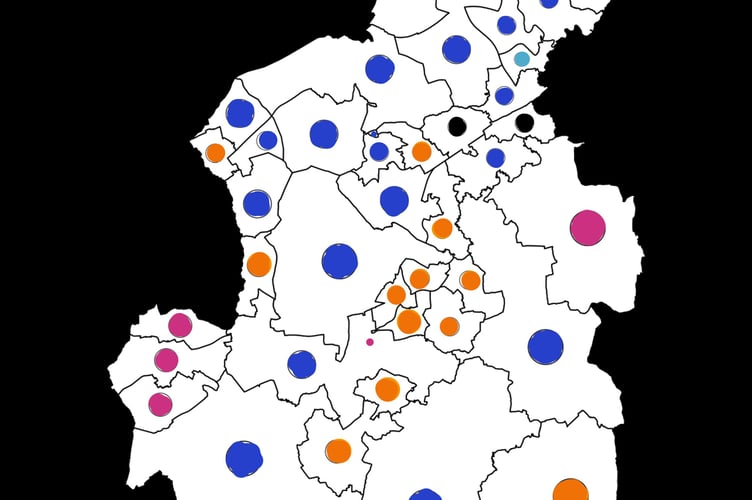
Surrey’s political map is looking far less predictable than it did five years ago, with Surrey County Council now under no overall control ahead of crucial elections in May 2026.
The Conservative Party has lost its majority for the first time since the 1990s, leaving a fragmented council where no single group dominates. With power up for grabs, the election is set to decide who can harness this opportunity and shape the new East and West Surrey councils.
From safe Tory majority to political battleground
Back in 2021, the Conservatives held a commanding position, winning 47 of 81 seats. The Liberal Democrats secured 14, while Residents’ Associations and independents held 16 seats combined. The Labour Party and the Green Party of England and Wales took two seats each.




Fast forward to now, and that dominance has eroded. A series of by-election losses, defections and political shifts has chipped away at Conservative control, culminating in a high-profile Liberal Democrat win in Hinchley, Claygate and Oxshott last year.
The Lib Dems, buoyed by strong recent performances, believe momentum is on their side heading into 2026 turning parts of Surrey into competing seas of orange and blue.
Fragmented council, rising pressure
Without a majority, the Conservative administration is now more exposed, relying on support from other groups. Criticism has intensified over key issues including finances, service delivery and infrastructure, all likely to dominate the campaign. Adding to tensions, the elections were delayed from May 2025 to 2026, a move opponents say has prolonged uncertainty.
Local politics defies party lines
Beyond the county council’s headquarters, Surrey’s political picture is even more complex.
Areas like Epsom and Ewell have long been strongholds for Residents’ Association groups, where hyper-local issues often outweigh national party politics. In contrast, districts such as Tandridge highlight split loyalties — Conservative at county level, but frequently led by residents’ groups locally.
The result is a county shaped as much by local identity as party allegiance, with independents often holding the balance of power.
Major shake-up: Surrey to be split in two
The 2026 elections come amid one of the biggest structural changes in decades. Surrey is set to be divided into two new unitary authorities, East Surrey and West Surrey, replacing the current two-tier system from April 2027.
The elections will create “shadow councils” to oversee the transition, with new boundaries and significantly fewer councillors. West Surrey will have 90 councillors across 45 wards, while East Surrey will have 72 across 36 wards. This redraw is expected to reshape political representation across the county.
The current councillors at the county, district and borough level will stay in place and act as responsible figures until April 1, 2027.
Key figures stepping down
The political reset is also marked by a wave of departures. Among those stepping down are county council leader Tim Oliver OBE and long-standing Labour figure Sir Robert Evans OBE, alongside several senior councillors from across parties and residents’ groups. Their exits add further uncertainty to an already volatile political landscape.
The issues: potholes, finances and the future
Despite structural changes, everyday concerns remain central. Potholes, council debt and the long-term direction of Surrey continue to dominate debate, with parties clashing over how best to manage services and finances during the transition to new authorities.
All to play for
As it stands, Surrey’s politics are more mixed than at any point in recent memory. With no party in control, strong performances from Liberal Democrats, entrenched residents’ groups and a weakened Conservative base, the 2026 elections are shaping up to be a decisive moment.
More than a routine vote, they will determine not just who runs the council but what Surrey’s political future looks like as it diverges in East and West.
Comments
This article has no comments yet. Be the first to leave a comment.