
AMERY Hill School year nine students were fortunate to be accompanied by historian Tony Cross when they visited the battlefields of the Great War and the Vimy Ridge National Historical Site of Canada.
Fierce fighting in 1914 and 1915 by French and British forces had failed to dislodge the Germans from the ridge, but in the spring of 1917 a largely Canadian assault took the fortified positions, but at a terrible cost in human life.
The students were able to examine the restored trench systems of both sides which in places were literally a stone’s throw apart and gained an appreciation of trench warfare and how the site fitted into the long timeline of the Great War.
Craters and trench systems, now visible as grassy humps and bumps in a wooded setting, were part of a system of earthworks which included underground passages which are open for guided visits. A relatively new interpretative centre provided information about the site, the battle of April 1917, and the area in general.




The recently restored Vimy Memorial was chosen for the placing by students of a wreath of poppies, a fitting symbol of remembrance. Carved on the walls of the impressive monument are the names of 11,285 Canadian troops who were killed in France and whose final resting place is unknown. The students were interested to learn that two Alton men were included in this number, men who had emigrated before the war but who joined the colours on the outbreak of war.
Some 7,000 Canadians are buried in more than 30 war cemeteries in the area and some students who visited the Givenchy Road Canadian Cemetery in the Memorial Park noted that all of the 100 who were buried were killed on the same day, April 9, 1917.
That all of the uniform headstones bore the maple leaf, the symbol of Canada, was also noticed along with the observation that the youngest casualty, Private Frank Aish, was just 16 years old – merely a couple of years older than the students themselves, and one of many patriotic youngsters who lied about their age to join the Army.
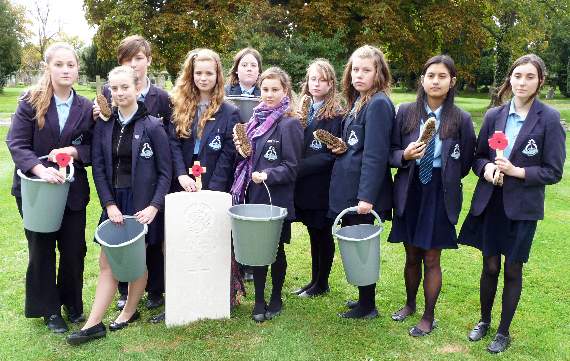
Having undertaken a recent visit to the battlefields of the Great War, a small group of Year 9 students from Amery Hill School spent some of their own time in Alton cemetery cleaning the gravestones, ahead of Armistice Day, of those who died in both world wars. They also placed a small cross bearing a poppy by the headstones in recognition of the sacrifice the men made on our behalf.
The students were surprised to see the range of ages recorded on the headstones and were interested to learn that they were provided by the Commonwealth War Graves Commission, which is tasked to pay tribute to the personnel of the Commonwealth forces who died in the two world wars.
They also maintain a roll of honour for civilians killed in the Second World War.
Alton cemetery is the last resting place of 21 service personnel and a number of other men are remembered on family headstones which were also “scrubbed up” where possible.
The girls discovered something of the effects of war through this simple activity, including a son lost at the Battle of Jutland, another lost while a prisoner of war in Turkey, and a third lost over Germany. The actions of the students provided an example of a small, but positive, act in remembering the fallen.
Comments
This article has no comments yet. Be the first to leave a comment.