
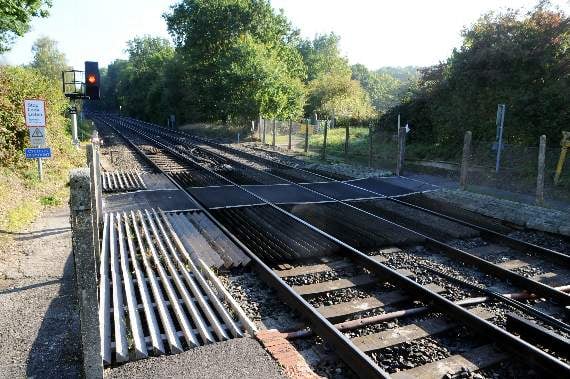
AN inquest into the death of an 83-year-old man hit by a train on an unmanned level crossing at Bentley has led to renewed calls by the family for safety improvements to prevent further tragedies.
Derek Thomas was returning from walking his dog Maisie in Alice Holt Forest on October 5 last year when he was struck by the 4.14pm through train out of Alton, bound for London Waterloo
The coroner’s court at Basingstoke heard on Tuesday that the grandfather of four was riding a mobility scooter across the barrow crossing on the Farnham side of the platform at around 4.20pm when the incident occurred.
Believing the fatality to be “a total accident”, South West Trains driver George Hornby said that his train was travelling at 70mph when he had sounded the horn at the whistle point before the station. He had not seen Mr Thomas on the line until he was three to four seconds away from him, and he had applied the emergency brake but the train couldn’t stop in time.
A post-mortem showed that Mr Thomas would have died instantantly from multiple injuries.
His black Labrador was later found fiercely protecting her owner’s body.
In describing the barrow crossing, Sergeant Mark Stook, of British Transport Police, said it was one metre wide with a non-slip coating and no gates or barriers but with a sign saying ‘Stop, Look, Listen’.
It was, he said, up to users to check to see if it was safe to cross.
Paul Tickner, of the Rail Accident Investigation Branch, said that the low afternoon sun and easterly wind gusts could have restricted the extent to which Mr Thomas could see or hear the train.
After the inquest, Graham Thomas, 77, from Alton, said of his brother’s death: “It was an accident, but in our view it was preventable.”
In stressing that the family did not in any way blame the driver, Mr Thomas pointed out that the tragedy had been borne out of a combination of bad conditions: the wind was in the wrong direction, blowing into the oncoming through train, the sun was low and too bright to look into, blocking the view of the approach loco, and there was a concrete post “in the wrong place” which may have prevented clear visibility for a scooter user along the track.
The family, said Graham, had flagged up the fact that the crossing was on a line built for steam but being used by up-to-date trains which were fast, quiet and didn’t rattle, and yet the crossing was old-fashioned and lacking in modern safety features.
The 12-coach train that had hit Derek weighed 350 tons without passengers, and it was travelling at a speed of 70mph.
They are calling for the immediate installation of warning lights believing that had Derek been alerted in this way he would have waited for the train to pass through.
As it happened, just a few seconds would have meant the difference between life and death.
“He was just in the wrong place at the wrong time,” said Graham, who added: “Network Rail claims the crossing is not a priority for special measures, but it is now. We need to prevent another death. Next time it could be a child.”
In referring to his brother’s death as “a failure by Network Rail to recognise the danger”, Graham said: “It can’t be a massive cost to install warning lights linked to the electrified line.” And he is adamant: “If Derek’s legacy is to improve the safety of the crossing for the village of Bentley, a community he loved, then his death will not have been in vain.”
Thought to be used by around 100 people per day, and more in the summer, Graham is fearful that while conditions on the crossing may have conspired to bring about his brother’s death, they could happen again. In urging Network Rail to act quickly, his message is clear: “One death is enough.”
At the inquest, coroner Andrew Bradley said that the Rail Accident Investigation Branch would be continuing its investigation into the crossing and would make any recommendations for improvements to Network Rail – an exercise expected to take “eight months to a year”.
He reinforced the family’s view that the crossing had been designed for 30mph steam trains so he would be interested to hear, he said, what the Rail Accident Investigation Branch would say about that.
The inquest jury returned a narrative verdict (recording the factual circumstances of a death, delivered instead of one of the standard short verdicts such as ‘accidental death’ or ‘unlawful killing’).
Comments
This article has no comments yet. Be the first to leave a comment.