
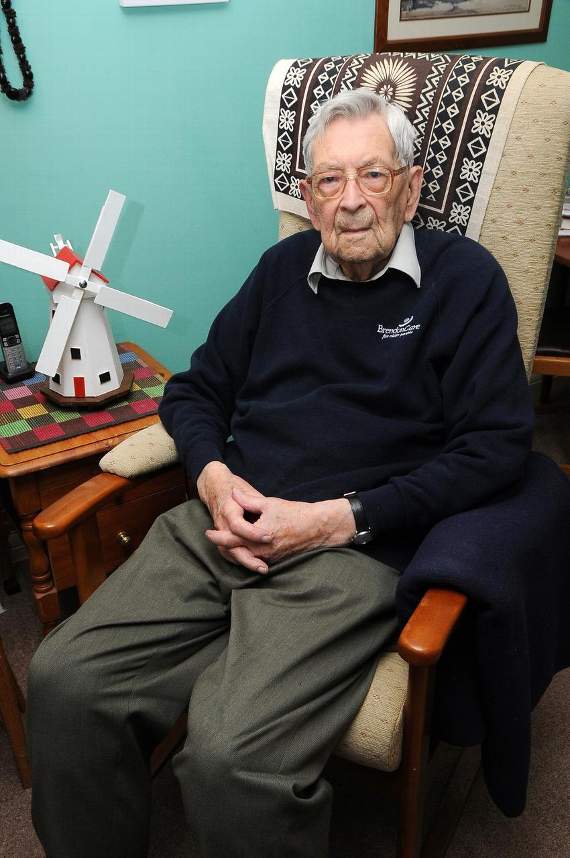
AS young and old gathered to lay poppy wreaths and plant crosses at memorials last week, marking the 100th anniversary of the end of the First World War, England’s oldest man, 110-year-old Bob Weighton, who lives in Alton, was reflecting on his early childhood in Hull during those four turbulent years.
He and his family survived Zeppelin raids, witnessed 10,000 troops marching through the city on the way to war with field guns drawn by horses, and recalled how his father and uncle, on a boating holiday, sailed near the German High Seas Fleet on exercises in the North Sea, a short time before war was declared.
At it did across the country, the First World War was to impact on the peaceful, cosy life of Bob and his family – he was one of seven children and his father was the local vet – and that of his neighbours who lived in the centre of the city.
He told the Herald: “At six I was, of course, too young to be aware of all the tensions which were building up in Europe but when the war came it affected us profoundly. Photographs of young men looking very self-conscious and serious in their new uniforms began to appear on mantlepieces and pianos of friends and neighbours.




“The word ‘France’ acquired a menacing significance. It was not just a foreign country – it was a place young men went and never came back. Pictures reached the newspapers of trenches, barbed wire and a landscape of shell craters, mud and shattered villages.”
He recalls the wooden tablets appearing on the corners of streets around them, bearing the names of those killed in action or missing. “And there were always a few flowers in a tin receptacle on the pavement below no matter how poor and mean the street.”
His father kept a map of the Western Front on the sitting room wall with small flags to mark the progress of the fighting. “And throughout the war the flags moved forwards and backwards by only small amounts.”
Bob saw his first plane, a bi-plane, while staying with family in Newcastle – probably in training before going off to France to fight the war in the air. Along the clifftops, soldiers were digging trenches in case of invasion.
“The war,” he said, “came very close to us in Hull when raids by Zeppelins began and I clearly remember being all huddled together under the stairs in the hallway during one of the first raids. The droning sound of the Zeppelin engines was clearly audible as it passed overhead and the thud of one explosion after another as the bombs dropped, coming nearer.
“Grandma was rocking to and fro moaning or praying and I was frightened but we became familiar with the wail of the sirens warning of an attack and then the ‘all clear’, There was, of course, no radar so only when the attackers had crossed the coast could a warning be given.
“There was also no defence apart from a few lone anti-aircraft guns somewhere down the Humber. So every night the blackout curtains had to be fixed over the windows and when the warning sirens went, mother brought us down from the attics and we lay down on a mattress under the big dining table until the raid was over.”
The first raid destroyed 40 houses and killed 24 people and the city continued to be bombed until the end of the war.
“I can remember watching from our attic window and seeing the flames leaping from Edwin Davis Furniture store, our premier store,” Bob continued. “Later it was rebuilt only to be destroyed in the Second World War.”
He was puzzled seeing his father go off in the evenings in a heavy blue overcoat, official cap and armband armed with a torch and a truncheon. “I had no idea what it was about unless German spies or looters were to be caught.”
Everyone was buying war saving certificates and his grandmother gave him 15/6d – about 78p today – to buy one. “And in five years’ time it would be worth £1,” he said
While newspaper cartoons lampooned the Kaiser, anti-German feeling was running rife and mobs attacked shops owned by German families and Germans were interred for their own safety.
Prices in the shops began to rise and in 1916 the price of a loaf of bread went up to 10d (4p) and saccharine tables were used to sweeten tea instead of sugar as things became scarce like toilet paper and
bananas.
So in spite of the shortages and the U-boat campaign in the North Atlantic to stop Britain getting supplies, it was surprising rationing wasn’t introduced until 1918.
The war ended when he was 10 and he remembers “being taken down with my brother with Grandma and Frances, our housemaid, to the City Square where jubilant crowds were singing, dancing and waving Union Jacks. Frances was to shy too join in the dancing.”
Bob added: “Sometime later there was an official Victory Parade with soldiers, sailors and civilian organisations taking part including the Special Constabulary and, for the first time, I saw my father marching along with them.”
Not long after the end of the war, a visitor remarked on the number of children in Bob’s family – to which his grandmother replied: “It is your duty to your country”.
The need to match the growing population of Germany, he says, “was occupying people’s minds”.
Comments
This article has no comments yet. Be the first to leave a comment.