
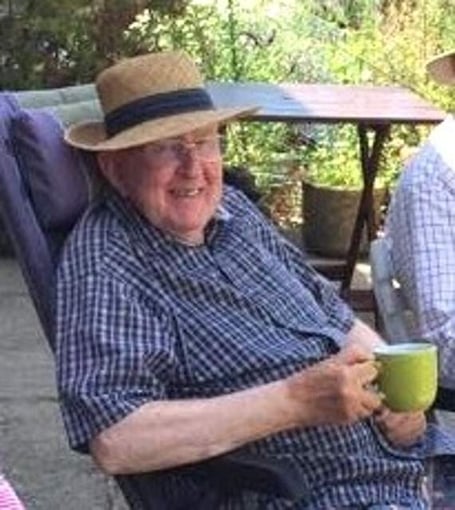
A RAIL Accident Investigation Branch (RAIB) report into the death of an 83-year-old man, hit by a train on an unmanned level-crossing at Bentley last year, has triggered renewed calls by the family for the introduction of a warning-light system to prevent further tragedies.
Derek Thomas was returning from a walk with his dog, Maisie, in Alice Holt Forest on October 5 last year when he was struck by the 4.14pm through train out of Alton, bound for London Waterloo.
While a January inquest into Derek’s death returned a narrative verdict (recording the factual circumstances of a death), the ensuing RAIB investigation has looked in minute detail at the circumstances surrounding the accident and has this week made recommendations which, his brother Graham believes, “do not go far enough”.
While citing the weather conditions at the time as having contributed to Derek’s decision to cross the track when it was unsafe to do so, too much emphasis, Graham believes, has been put on his brother’s confinement to a mobility scooter and not enough on the fact that anyone crossing the line at that point, especially a child, may have made a similar mistake.


And, while the RAIB has recommended making improvements to the type of fencing used alongside the track – the posts of which may have restricted the view of the track from a scooter– and that Network Rail should modify its crossing management processes “so that they consider mobility scooter use at all crossings which rely on users looking and listening for trains”, Graham feels this does not fully address the issue.
Well used by walkers and cyclists as the footpath route into Alice Holt Forest, and as the start of the popular Shipwright’s Way, Graham Thomas believes the obvious and most responsible solution would be to install a red and green lighting system to warn crossing users of an approaching train. Otherwise, he fears, it is “another accident waiting to happen, and this time it could be a child”.
The RAIB records how Derek Thomas, a regular user of the crossing who lived in Bentley, was riding his mobility scooter across the “footpath crossing” on the Farnham side of the platform at around 4.20pm when the accident happened.
CCTV footage shows that Derek had successfully negotiated the crossing on his outbound journey some 38 minutes earlier, when he had appeared to pause to follow the “look and listen” code for unmanned footpath crossings such as these, which do not have a barrier.
In the report summary, it states: “Users of Alice Holt footpath crossing are required to look and listen for approaching trains before deciding whether it is safe to cross the line. It is uncertain why the user decided to cross when it was unsafe to do so, as CCTV images suggest that he had previously crossed in a safe manner. It is probable that the user did not see the train or misjudged when it would arrive at the crossing, perhaps due to sun glare, when deciding to cross. The mobility scooter user’s opportunity to see the approaching train was limited by the design of Alice Holt crossing, in particular the fencing. The mobility scooter user did not react to the train’s horn, possibly because he did not hear it.”
The report goes on to detail the low level of the sun, the “glare” from which could have prevented Derek from seeing the approaching train, and the strength of the wind which could have contributed to him not hearing the warning whistle that was sounded by the approaching train as it passed the whistle point further down the line toward Alton.
It is thought that the positioning of a fence post may also have contributed to his failure to see and hear the approaching train, which would have been travelling at 70mph as it passed through the station.
While the post and fencing have since been replaced, and the whistle point has been moved back to extend the warning time, Graham believes through trains shouldn’t be travelling at speed when passing through the station. As soon as he saw someone on the line, the train driver applied the emergency brake but, had it been a stopping train, slowing down as it approached the station, his brother believes Derek may still be alive.
While RAIB investigations are undertaken “to improve railway safety by preventing future railway accidents or by mitigating the consequences” and “not to establish blame or liability”, Graham Thomas believes the report “does not go far enough” in its bid to improve safety.
Too much emphasis, he believes, has been put on the fact that Derek was “a vulnerable user” on a mobility scooter which was slow to manoeuvre and had a maximum speed of just four miles per hour, and not enough on the fact that, taking into account the mitigating circumstances, the crossing could have posed a risk to any user.
While footpath crossings are normally inspected by Network Rail at two-yearly intervals, prior to Derek’s accident the last risk assessment at Alice Holt had been carried out on September 1, 2015, “as a consequence of a near-miss incident”.
With this in mind, the Thomas family believe more needs to be done to make the crossing safe.
“Flashing warning lights must be the answer for all footpath crossing users,” said Graham.
Comments
This article has no comments yet. Be the first to leave a comment.