
JANE Austen would have had a field day analysing the behaviour on Tuesday evening of a parish council at war.
Emotions were running high as the historic village of Chawton continued to grapple with a parking problem, generated by an enduring attraction to the author and the place she liked to call home.
An association that has and will continue to afford it protection, as part of Britain’s literary heritage, coupled in more recent times with its place in the South Downs National Park, Chawton, with its picture postcard charm, acts as a magnet for visitors, particularly at weekends, when the lack of facilities have led to unacceptable levels of on-street parking.
It is a problem flagged up in the Chawton Parish Plan, adopted by East Hampshire District Council (EHDC) in 2014, and outlining an action plan which Chawton Parish Council has been working to progress.
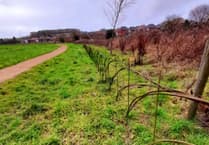



But at the annual meeting in the village hall on May 31, the realisation of what this could mean triggered outrage, with residents demanding that councillors show their hand over one course of action which would see the construction of a visitors’ car park, on the fringe of the village, funded by the provision on the same site of six new houses.
A counter proposal, by councillor Jacqueline Forward and supported by chairman Edward Stevenson and councillor Andrew Gleadow, was to look instead at making better use of existing car parks in the village and to restrict on-street parking.
The ensuing debate led to a declaration of ‘no confidence’ in those four councillors (Tim Chilton, Robert Isaac, Richard McLaren and Malcolm Williamson) who supported the bringing forward of a new village car park on a field just off the A31, and the raising of a 70-signature petition demanding their resignation.
On Tuesday, the parish council met once again, this time in the period elegance of Chawton House where the peace was shattered by an astonishing display of bad grace, aggression and bad manners as, faced with a vocal and at times hostile audience, councillors fought to justify their positions.
Residents’ anger had been fuelled by the revelation that the vice-chairman, Mr Williamson, had taken upon himself to approach the South Downs National Park Authority asking for its view on the idea of providing a new car park on the fringe of the village and of using the opportunity to build six new homes to offset the cost.
The six homes, it was heard, would address Chawton’s projected housing quota to the year 2023.
The idea would be for access from the Chawton roundabout, on the A31, possibly withdrawing access to the village from Wolfs Lane, which would stop vehicles, and particularly coaches, travelling through the village.
The car park could also be used by parents dropping off and picking up school children, with a pedestrian access across the field to the rear of the school, to avoid walking along the road.
But it was a proposal that, despite having been flagged up in the parish plan, had come as a shock, drawing strong objection from the residents. Those present did not support that option and were angry that an e-mail had been sent unilaterally to the national park authority, on behalf of the parish council, but with no knowledge of neither the clerk nor other councillors, a move which they viewed as “underhand” and lacking in transparency.
They, it seemed, were supportive of the less radical option, preferring instead to explore the possibility of opening up the dead end on the Old Gosport Road for parking, and of improving and making better use of the car park at the village hall and at Redemptorist Publications which, is was suggested, could be used at weekends, as well as the village centre car park, owned by Fullers Brewery but leased to EHDC. The concern was that the lease is currently up for renewal and that the district council may not necessarily renew it.
There were suggestions on the table also for limiting on-street parking to residents only, and to free up the conservation area from vehicle clutter by the creation of a restricted parking zone which would enable control of parking without damage to the historic environment by avoiding the use of yellow lines and intrusive signage.
While a suggestion was put forward by Mr Williamson that a sub-committee should be set up to look at all the options, to come back to committee in December, Mrs Forward felt it was a waste of time and that action should be taken straight away to implement some of the softer options, using and upgrading existing facilities.
With the council obviously at loggerheads, what the residents really wanted was for the four councillors to resign, which they refused to do, arguing that they were there to represent the views of the whole village, comprising an electorate of 384 not just those present or the 70 signatories on the petition, and that it was incumbent on them to examine all the options before coming back to the village as a whole to make a decision.
Mrs Forward suggested that a way forward could be for all seven councillors to resign to enable the village to elect a new council in whom they may have more confidence – a suggestion councillors agreed to deliberate upon.
Comments
This article has no comments yet. Be the first to leave a comment.