
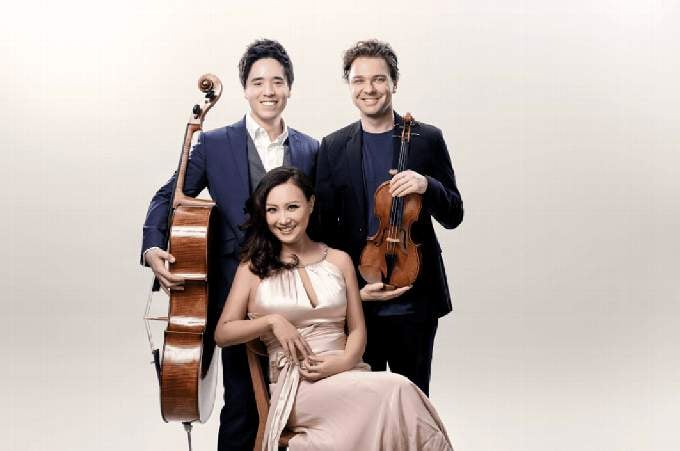
The Sitkovetsky Trio
The Sitkovetsky Trio
Click to buy photos from our newspaper ?
Printed and digital download photos available



The Sitkovetsky Trio will perform the next HHH concert at St Christopher’s Church in Haslemere on November 27.
Alexander Sitkovetsky (violin), Wu Qian (piano) and Isang Enders (cello) will perform Schumann’s Fantasiestücke, Op. 88, Arensky’s Piano Trio No. 1 in D minor, Op. 32, and Tchaikovsky’s Piano Trio, in A minor Op. 50.
Tickets, priced £18, are available from Chamberlain Music, on line from Eventbrite at https://www.eventbrite.co.uk – search for HHH – or on the door.
The last HHH concert saw artistic director Philip Berg bring outstanding violin and piano duo Mathilde Milwidsky and Joseph Havlat to Haslemere.
If there were fireworks outside during the concert on November 6 we didn’t hear them, for the fireworks inside were breathtaking.
First up was Ludwig van Beethoven’s Sonata No. 8 in G major, the last in a set of three Sonatas for Piano and Violin composed in the summer of 1802.
Later that year he was to write despairingly of his growing deafness and his determination to overcome this tragedy: “I will seize fate by the throat – it will certainly not crush me completely.”
None of that turmoil shows in this sunny sonata. The series title shows the piano was intended to be leading instrument, not accompaniment. But in Milwidsky’s hands the violin was not to be subdued and gave equal measure in the eloquent exchange of ideas.
In the finale she became for a while the village fiddler, as Beethoven leapt into bucolic dance, then into fugue, then back again. I’m sure we could hear bagpipes somewhere in the lively finish.
The Fauré sonata which followed began with a joyful idea tossed out by the piano. The violin responded and the instruments danced nimbly together. We were at once in a different landscape, lushly romantic, with broad sweeping chords and restless themes on rising scales.
After an interval, the duo performed Richard Strauss’s 1888 Sonata for Violin and Piano.
The concert ended with Szekely’s arrangement of Bartok’s Romanian Folk Dances, and an encore for the massively appreciative audience was a barcarolle – an arrangement of Debussy’s song bearing that name.
Martin Robson