
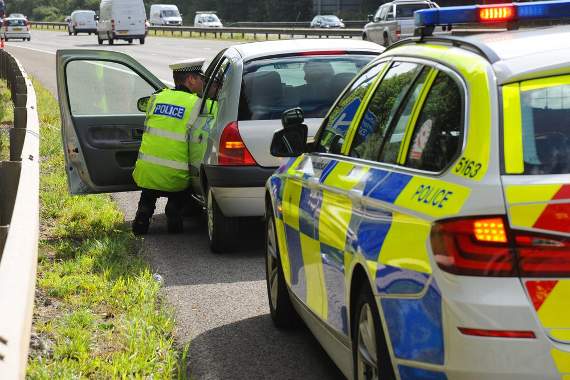
POLICE in Hampshire are cracking down on drivers with poor eyesight.
Every motorist stopped by roads traffic officers during September will be required to read a number plate from 20 metres.
If any driver fails they will have their driving licence immediately taken away from them, senior officers warned this week at the start of the month-long campaign.
Data collected during the tests will be used to improve police’s understanding of the extent of poor driver vision.



The initiative is being run by forces in Hampshire, Thames Valley and the West Midlands, and is supported by road safety charity Brake and opticians Vision Express.
Sergeant Rob Heard, who represents the police forces taking part in the campaign, told The Herald: “Not being able to see a hazard or react to a situation quickly enough can have catastrophic consequences.”
He warned officers would be carrying out eyesight checks ‘at every opportunity.’
Officers can contact the DVLA and request an urgent revocation of a licence if they believe the safety of other road users will be put at risk by allowing a driver to remain on the road.
The power to make such a drastic decision was introduced in 2013 under Cassie’s Law, named in memory of 16-year-old Cassie McCord, who was killed when an 87-year-old man lost control of his car in Colchester, Essex.
It emerged the pensioner had failed a police eyesight test days earlier, but a legal loophole meant he was allowed to carry on getting behind the wheel.
Brake and Vision Express want a recent eye test to be required when licences are renewed every 10 years.
Under current rules, the only mandatory eye sight check takes place during the practical test, when learners must read a number plate from 20 metres.
Once someone has obtained a full licence, it is up to the motorist to tell the DVLA if they develop a problem with their eyesight.
Brake’s campaign director Joshua Harris said: “It is frankly madness that there is no mandatory requirement on drivers to have an eye test throughout the course of their driving life.
“Only by introducing rigorous and professional eye tests can we fully tackle the problem of unsafe drivers on our roads.”
Research by the Association of Optometrists published last November found more than a third (35 per cent) of professionals who carry out eye tests, saw patients in the previous month who continued to drive despite being told their vision was below the legal standard.
A study by insurance firm RSA in 2012 estimated poor vision contributed to 2,874 casualties on the roads over a year.
Vision Express chief executive Jonathan Lawson said: “We believe official Government statistics on the impact of poor sight on road safety are the tip of the iceberg and we know the public feel the same as we do about tackling poor driver vision.”
Steve Gooding, director of the RAC Foundation, said: “The human cost of driving with failing eyesight and having an accident can be immeasurable.
“Drivers mustn’t just keep their eyes on the road, they must ensure they can see what’s ahead.”
Comments
This article has no comments yet. Be the first to leave a comment.