
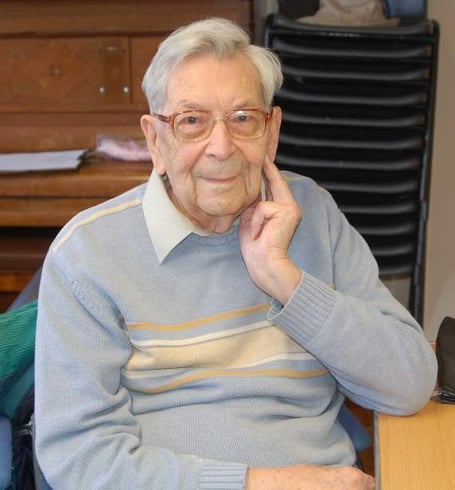
ADMITTING it was “extraordinary” and something he never expected to happen, at 108 Robert (Bob) Weighton, from Alton, is the UK’s oldest man, sharing the title with Alfred Smith in Perth, Scotland – both men having been born on March 29,1908.
“However,” he said modestly at his cosy flat in the grounds of Brendoncare where he lives a busy, independent life, “it is really only a matter of words. I haven’t done anything to get it.”
Although Bob now goes into the record books there will be no celebrations like those on his birthday when last year he had two parties, two cakes and dozens of cards, including one from the Queen.
At 108, he still likes to get out and about and meet people and he walks to nearby Waitrose to get his shopping.

“I do know a lot of people in Alton and they often stop me in the street, although I can’t always remember their names. However, I don’t travel anywhere at night now. I like to be back in my home where I have everything I need. And Brendoncare are marvellous and are there when I need them,” he said.
Bob is now preparing for the festive season and plans to have his Christmas dinner “with others on their own” at St Lawrence Church Parish Centre in Alton “where I am not sure if we will have any wine with the meal but I will be having drinks with my family, and there are quite a few of them, when they come to call in the days following”.
The centenarian has lived through two world wars and witnessed history first hand as he was working in America when the bombing of Pearl Harbour brought the United States into the Second World War.
“The President then was the great FDR Roosevelt but he died before the war ended and Harry Truman took over,” said Bob. “Now we have Donald Trump, don’t know what is going to happen there, and in England Brexit, so it shows politics are as changeable as the English weather.”
A man of intellect and many interests Bob, who has a wry sense of humour, was born in Kingston-upon-Hull, Yorkshire, on March 29, 1908, one of seven children. His father was the local vet.
“He used to have to cycle out to the farms to tend to sick animals and I used to help him in his surgery to neuter dogs, for which he charged five shillings (25p),” said Bob.
His father paid an extra £3 a term so he could stay at school until he was 16 and enable him to take up a marine engineering apprenticeship on Tyneside.
“By the time I was qualified it was the Great Depression and the shipping industry was closing down. There were no jobs and it was the time of the Jarrow March and terrible hardship,” he said.
He escaped the poverty he was seeing all around him by getting a teaching job with a missionary school in Taiwan. It took six weeks to get there and before he could begin teaching he had to spend two years in Japan learning the language.
In 1937, Bob married Agnes, a teacher he had known since they studied together in England, and after their wedding in Hong Kong they returned to Taiwan where their first child, David, was born.
“Having worked for seven years I was due for some home leave,” he said, “But this was August 1939 and on our way home, as we crossed the Pacific, we heard England was at war and the ship was diverted to Vancouver.”
With no chance of getting to England he was invited by a friend to go to Toronto.
“I was still being paid by the school so we settled there and my other two children, Peter and Dorothy, were born.” Sadly, Peter died two years ago.
Robert took on a job with the British Air Commission but instead of sending him to England he went to America, to the Pratts Whitney factory in Connecticut, “where they were making aeroplanes for Britain to help them fight the war”.
“At that time the Americans were very laid back about the war as they felt they would never have to be a part of it, until the Japanese attack on Pear Harbour, and then we were all buddies.”
He moved onto Washington and it was here his knowledge of Japanese landed him a job with the British Political Warfare Mission, monitoring what was going on in Japan, “as well as trying to ruin the morale of the Japanese fighting forces”.
He was also working closely with the American Secret Service and because he was employed by their government, “my salary doubled and I was able to send for my wife and children to come and live in Denver”.
“It is a lovely place,” he said.
The end of the war meant Robert could no longer stay in America.
“I was classed as an alien and we went back to Cornwall to stay with my wife’s parents. It was the first time they had met me after 13 years of marriage.”
Again he found it hard to get a job but eventually took up a teaching post at City University, London, and he and his wife settled in a house in Hatch End, near Pinner.
“Sadly my wife, who died 19 years ago, contracted terrible arthritis and so we needed to find a bungalow. We found the one we loved in Greenfields Avenue, Alton, and moved in 1973.”
Robert has always been closely connected with Alton Methodist Church and is also an honorary member of Alton Society. Since his retirement, he has also written a book about his childhood called ‘When We Were Seven’. He is now writing a second book continuing his life story.
“I don’t know when it will get published,” he said.
When he turned 107 Bob, who as well as his son and daughter has 10 grandchildren and 25 great-grandchildren, said he had no idea why he has lived so long and stayed so healthy and active.
“I used to play a lot of sport, football as a lad and a lot of tennis in Taiwan, maybe that has kept me fit.”
Paying tribute to his grandfather, Magnus Weighton said: “He doesn’t like to stay at home, he likes to be out and about and loves meeting people. He is a remarkable gentleman.”
Comments
This article has no comments yet. Be the first to leave a comment.