
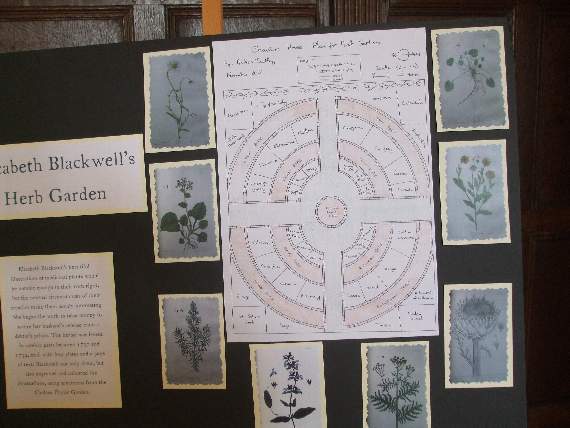
THE assembled guests in the Great Hall of Chawton House Library were introduced to the life and times of Elizabeth Blackwell, the 18th Century herbalist who is commemorated in the new herb garden, by Dr Gillian Dow, and the garden was officially opened by Her Majesty’s Lord-Lieutenant of Hampshire, Nigel Atkinson.
Elizabeth’s two-volume Curious Herbal work is held in the library collection.
Elizabeth Blackwell (born Blachrie), was a merchant’s daughter born around 1700 in Aberdeen, Scotland. Her husband, Alexander Blackwell, was challenged for practising medicine without a licence and the couple had to leave their homeland.
In London, he set up business as a printer, once again without following the obligatory trade regulations and was duly fined, couldn’t pay the fines and was thrown into debtors’ prison. This chain of events began Elizabeth’s pioneering work when, in order to provide for herself and her child, she determined to produce a herbal. Having received tuition in drawing and painting, she made detailed botanical drawings of plants and later took them to Alexander in prison where he would use his medical knowledge to provide descriptions for their use.


Elizabeth was responsible for sketching, engraving and hand-colouring the illustrations. Between 1737 and 1739 she published four plates each week until 500 images had been produced. The complete work was then published in two volumes as “A Curious Herbal containing 500 cuts of the most useful plants, which are now used in the practice of physick, to which is added a short description of ye plants and their common uses in physick”. Her achievement would normally have taken three artists and craftsmen.
Previously, all of the major English herbals – Gerard (1597), Parkinson (1640), and Culpeper (1653) – had been produced by men, but Elizabeth’s herbal appeared at a critical time that saw the gradual emergence of botany as a science distinct from simply the medical uses of plants and botany became widely accepted as the one suitable branch of scientific study for women. What marks out Blackwell’s herbal is the quality of the illustrations. Many of them are based on detailed observations of specimens being grown at the Chelsea Physick Garden, where she was supported and encouraged by Sir Hans Sloane, Richard Mead and Isaac Rand, the apothecary and the Physick Garden’s curator.
Herbals were, of course, closely tied to gardens like the Chelsea Physick garden, and the interpretation of a herb garden at Chawton House Library honours that link, although for women living at estates like this one, some of the most important medicinal herbs had still to be foraged in the fields and hedgerows rather than picked in the comfort of the garden.
The Royal College of Physicians endorsed Elizabeth Blackwell’s book and it became a financial success, enabling her to secure Alexander’s release from prison. In 1742, Alexander once again left his family to travel to Sweden, taking the remaining funds from the book, but he was subsequently executed for treason in 1747 after becoming embroiled in a political conspiracy concerning the Swedish line of royal accession. Elizabeth died approximately 10 years later, in 1758. She is buried in the churchyard at Chelsea Old Church.
This is the first project that gardener Andrew Bentley has attempted at Chawton House Library, made possible by the generous financial support of the Stanley Smith Trust and Fiona Sunley, of Godmersham Park, and the support of the trustees and staff at the library and inspiration from Petersfield Physic Garden as well.
Designed in November 2015, begun in mid-February, the hard landscaping was finished on May Day. Neil and Catherine, of nearby Pepperpot Nurseries, had been incredibly helpful in supplying many herbs, as was Kirton Farm, near Sparsholt, where Andrew trained.
Since apothecary books have four categories, the garden was designed similarly with three beds in each quadrant relating to the head, chest, skin and digestion, and the delicious canapes served during the gathering contained borage and lemon balm from the garden.
During 2017 the herb garden will open on set days under the National Garden Scheme and Andrew hopes that the first plant fair will be in August 2017.
Comments
This article has no comments yet. Be the first to leave a comment.