
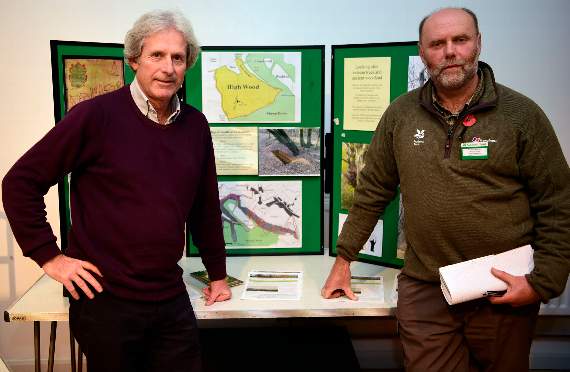
CHRIS Webb, the National Trust’s head warden for East Hampshire, introduced the charismatic biodiversity adviser of the Game and Wildlife Conservation Trust, Peter Thompson, at the Friends of Selborne Common’s annual talk.
The large audience was treated to a lively and fast-moving illustrated talk on November 12 on the progress that has been made to Mr Thompson’s work helping with the development of The Selborne Landscape Partnership, a farmer-led cluster formed 18 months ago involving 18 land managers around the village of Selborne.
Farmer clusters encourage landowners and managers to work together on a landscape scale rather than as individuals on separate holdings.
Liz Truss, the former Secretary of State for Environment, Food & Rural Affairs, has given enthusiastic support on recent visits to the Friends of Selborne Common, saying: “The Selborne farmer cluster is a great example of responsible landowners thinking beyond their own fields, meadows and woodlands, looking at the wider landscape to deliver greater environmental benefits on a larger scale.”

She went on to say that what the partnership is doing in Selborne is what she would like to see become “business as usual” for farmers across the country.
Peter has helped with the development of farmer-led The Selborne Landscape Partnership, since it encourages landowners and managers to work together on a landscape scale rather than as individuals on separate holdings.
The land managers include 18 local farmers, The National Trust (Selborne Common & Long Lythe), Hampshire & Isle of Wight Wildlife Trust (Noar Hill National Nature Reserve), the Gilbert White Museum and the Farming and Wildlife Advisory Group. The Game & Wildlife Conservation Trust and South Downs National Park Authority have been involved in providing support for the project from its outset working with farmers, not as a top-down system stemming from government.
Mr Thompson, with his passion for landscape and the environment, gives advice to farmers and land managers across England on practical methods of implementing conservation programmes developed by Game and Wildlife Conservation Trust’s farmland ecology unit. He is a qualified agronomist who spent 10 years advising farmers on agronomy before joining the conservation trust in 1988.
He is also Hampshire co-ordinator for the Campaign for the Farmed Environment and his well put together notes and colourful slides helped the audience to learn about how the landscape is managed in terms of production, biodiversity and wildlife conservation, adding that The Game & Wildlife Conservation Trust, National Trust and Friends of Selborne Common are charitable, not-for-profit organisations.
There was a lively question-and-answer session covering a huge range of topics that were of particular interest to members of the audience. Mr Thompson commented on one of those as the evening neared its end when someone raised the thorny question of badger control.
He said:?“We had almost got through the whole evening without the controversial subject of badgers being raised. A boon or a threat?”
He addressed the question fairly and squarely saying that badgers can’t help but leave a huge mark on any area that they move into and they will eat hedgehogs, which are in decline, and can introduce TB to cattle. He concluded that the badger fuss is not a storm in a teacup.
Another question was about the rising numbers of deer in the countryside, a good thing or detrimental? Mr Thompson answered simply that deer numbers have exploded and that culling is a necessary part of conservation since a lot of damage is being done on a large scale by deer to the countryside and other wildlife.
Comments
This article has no comments yet. Be the first to leave a comment.