
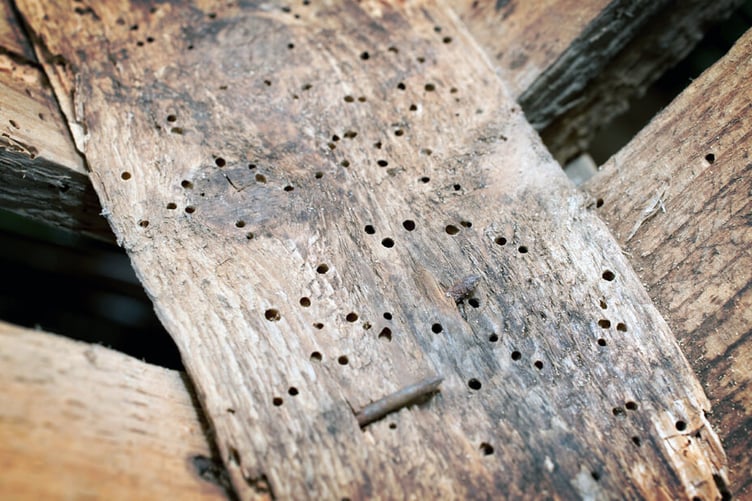
Rentokil, the well-known pest control company, completed its first full year of operation almost 100 years ago, writes Roy Waight.
It was founded in 1925 by Elizabeth Eades to commercialise the discoveries of pioneering entomologist Harold Maxwell-Lefroy.
How many people know of the connection between Crondall and this company which today employs 50,000 people and has annual sales of £5 billion?
Harold came from a long-established line of Lefroys of Itchell Manor in Crondall. Henry Maxwell bought the manor of Itchell in 1773. He proved a popular and generous landlord and had the grounds of the manor laid out by Capability Brown.



Tragedy struck in 1789 when Mrs Maxwell was burned to death after her dress caught fire. Henry Maxwell, who had no children, left the manor to his wife’s nephew, the Rev John Henry George Lefroy, who in turn left it to his son, Charles Edward Lefroy.
Incidentally, this gentleman, Harold’s paternal grandfather, discovered the famous Crondall Hoard — a collection of more than 100 Anglo-Saxon coins — when he was 18. He went on to become the much-admired squire of Itchell Manor and did much to help the poor of Crondall during the agricultural depression of the “hungry 40s”.
When Charles Edward Lefroy died in 1861, Captain Charles James (CJ) Maxwell-Lefroy inherited the manor, the name becoming double-barrelled in 1875. His son, Harold Maxwell-Lefroy, was born in 1877. Harold was brought up at Itchell Manor, surrounded by many servants in a rambling house full of ghosts and their hauntings.
He went to school at Church Hill House in Crondall, where one of his contemporaries was the celebrated aviator Claude Grahame-White. Harold later studied in Germany before going to Marlborough College. He started at King’s College, Cambridge, in 1895, receiving a first-class degree in natural science. Thus began an illustrious career in entomology.
In 1903, Maxwell-Lefroy was appointed entomologist to the government of India. But tragedy struck. In 1910, Harold’s son Denis Charles died from a flyborne disease, and his other son, Cecil, was immediately sent away to safety in Darjeeling. Harold returned to England in 1911. The tragedy of Denis’s death prompted Harold to study how to eradicate insect pests.
Harold subsequently took up a position at Imperial College as professor of entomology. At this time, the principal architect of the Office of Works, Frank Baines, was charged with restoring the great hammerbeam roof of Westminster Hall, which, as everyone knows, was framed in Farnham.
In 1913, Baines consulted Maxwell-Lefroy about ways of exterminating the death watch beetles that had been found in Westminster Hall. Maxwell-Lefroy began to try out various chemicals and, finally, came up with a 50 percent dichlorobenzene, 47 percent mineral oil and 3 percent barium oleate mixture to brush the wood with. It worked.
In 1924, to manage a stream of requests, Maxwell-Lefroy and his assistant Elizabeth Eades started producing bottles of a woodworm treatment fluid from a small factory in Hatton Garden. This led to the formation of Rentokil Limited in 1925. Harold originally tried to register the company as Entokill, but this was objected to by the Board of Trade since a similar name was already registered.
Maxwell-Lefroy succumbed to his own researches in 1925. In March 1925, while experimenting in his laboratory on poison gases to control houseflies, he passed out. He was administered oxygen and recovered. But in October 1925 he was not so lucky. His wife, alarmed at his absence, went to his laboratory and found him collapsed.
He died in hospital on Wednesday, October 14, 1925, without regaining consciousness. He had been experimenting with Lewisite, an organoarsenic compound later used as a chemical weapon. The death was widely reported in the press, with some hinting at suicide. Elizabeth Eades bought the company from Harold’s widow and managed the growing business for three decades.
Anyone interested can read the memoir of Harold’s son, Cecil Anthony Maxwell Lefroy CBE, who became a general manager of the Burmah Oil Company, posthumously edited as a biography and published in 2015 by Laurence Fleming.
Frank Baines was knighted for saving the great hammerbeam roof. Maxwell-Lefroy’s contribution was largely forgotten. But it is pleasing to know that the great roof was not only framed in Farnham, but saved with the help of a local man.
Roy Waight is chairman of the Farnham and District Museum Society. Anyone interested in joining the society should visit farnhammuseumsociety.org.uk.
Comments
We've recently changed our login process. If you have an account for commenting, you will need to re-register on the login window.
This article has no comments yet. Be the first to leave a comment.