
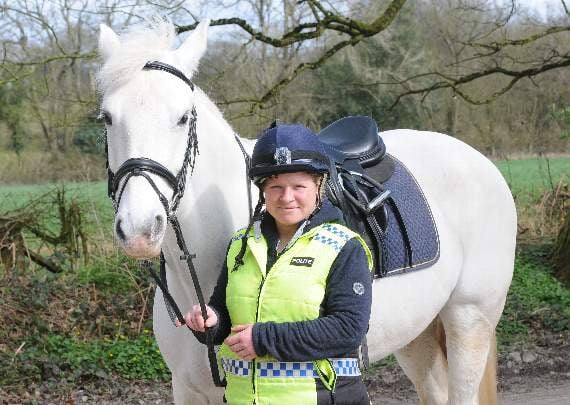
HORSE riders in the Medstead area have resorted to wearing head cams following two serious incidents on the roads – one of which resulted in one horse being destroyed as well as leaving riders and animals traumatised.
So incensed was Bridget Bayliss after her daughter Milly, 25, returned home badly shaken after being run off the road by a 4x4 vehicle, she has mounted a campaign to try to address the problem.
In urging drivers to show more consideration by slowing down and passing “wide and slow”, she is adamant: “Our roads need to be safer to ride on before someone looses their life.”
It is not the first time Milly has been involved in a close shave on the lanes close to the Medstead yard where she keeps her horses, but this was the final straw.


According to Mrs Bayliss, two weeks ago Milly was “riding and leading” along the Bentworth to Medstead road when “a silver four-wheeled drive vehicle came past her so fast it caused the horse she was riding to spook and rear”, causing her to lose the horse she was leading, Dolly, who broke free.
Thankfully, another motorist stopped to check if she was okay and helped her retrieve Dolly.
Mrs Bayliss said: “It really makes me so angry. Milly was left very shaken. This is becoming a very dangerous situation.”
She went on to explain how less than a month ago her friend had been the victim of a similar incident which caused her horse to fall. The horse broke his leg and had to be destroyed.
“We need to have the speed limits reduced to 30mph in the surrounding areas of Medstead,” said Mrs Bayliss, who added that many riders had now taken to wearing head cams so that they can record any other such incidents which need to be reported subsequently to the police.
As a former rider and amateur jockey, county councillor Mark Kemp-Gee understands the dangers faced by riders who are often forced to use the roads in order to exercise their animals.
He said: “I know how important it is that drivers on our rural roads should exercise great caution when overtaking horses and riders. This is particularly important since, not for nothing, the Medstead and Bentworth area is known as the capital of equestrianism in Hampshire.”
In particular, he expressed concern about the speed of traffic using the Bentworth to Medstead road and has been trying to instigate improvements.
Mr Kemp-Gee said: “We have just put in a 40mph limit along the Medstead side of New Copse as you approach Bentworth and have helped to install new impact gates at the 30mph signs. We (Hampshire County Council) shall monitor the 40mph which was deliberately put in to protect New Copse residents and walkers, cyclists and horse riders crossing the road from Jennie Green Lane/Bentworth BOAT 23, but if it has no effect we shall have to strengthen these traffic-calming measures.”
And he added that greater knowledge and education of drivers with regard to horse and pony activity on our rural roads was “vital”.
It is the main thrust of the British Horse Society’s ‘Dead Slow’ campaign, launched in a bid to educate drivers on how to safely pass a horse on the road.
Society statistics show that in the past year there were 31 recorded road incidents in the South of England (Berkshire, Buckinghamshire, Hampshire, Isle of Wight and Oxfordshire), resulting in the death of two horses – one of which was in Hampshire, which recorded nine of the 31 incidents.
The British Horse Society has joined the Department for Transport to produce a THINK! video which urges drivers to “slow down to a maximum of 15mph when they meet a horse and rider on the road, and to leave at least a car width between their vehicle and the horse, passing wide and slow, without revving their engine or sounding their horn”.
A Society spokesman said: “Horses can be unpredictable, and even the most well-trained horse can react to its instincts and want to move quickly away from what they consider to be a threat.
“It is worth remembering that there are three brains working when a horse and rider meet a vehicle on the road – the driver’s, the rider’s, and the horses’.”
The spokesman added: “The network of safe off-road bridleways and byways for riders are under threat, with some routes becoming completely inaccessible for horse riders. Quite often, horse riders are riding from a riding school to a bridleway or from one bridleway to another, forcing them onto the roads.”
Comments
This article has no comments yet. Be the first to leave a comment.